INFODICY: FRACTALITY AND THE ETHICS OF DIFFERENCE (An Essay in the Justification of the Primacy of Information over Matter). Part I
- I. Time as the Price of Difference
- II. Entanglement as an Ontological Good
- III. Information as the Ground of Being
- IV. The Axiology of the Triad: Information ↔ Void ↔ Chaos
- V. Consciousness as a Local Good and an Act of Self-Observation
- VI. The Gestalt-idea as a Stable Pattern of Distinction
- VII. DNA: The Blockchain of Life
- VIII. Νοητόν (noēton): The Chemistry of Another Mode of Perception
- IX. Being Without a Demiurge
- X. On the Threshold of a Big Bang of Another Kind
- XI. The Artist on the Edge of Meaning
- XII. Physics in the Plural
- See continuation: Part II
“It from bit”
John Archibald Wheeler
“Reality is a very subjective affair. I can only define it as a kind of gradual accumulation of information. Reality is inexhaustible.”
Vladimir Nabokov
“Ce qui ne se compare à rien n’existe pas.”
“That which can be compared with nothing does not exist.”
Paul Valéry
“Tout ce qui se passe et qui apparaît est de l’ordre de la différence.”
“Everything that happens and appears belongs to the order of difference.”
Gilles Deleuze
Can one speak of ethics in relation to the fundamental structures of reality? Can one ask where, in physics, the boundary between good and evil might lie? And, finally, can natural phenomena be judged at all in the categories of good and evil? At first sight, such questions may seem either gratuitously provocative or alarmingly primitive. Ethics is traditionally regarded as a human concern, physics as the domain of impersonal laws. The boundary between them appears self-evident. Yet shift the angle of view only slightly, and that boundary begins to blur.
Suppose that time is not merely a fourth coordinate, but the price reality pays for the possibility of preserving differences. Suppose that space is one of the conditions that keep differences from coinciding at a single point. Suppose, finally, that matter may be secondary to an informational ground, while the reality accessible to us is only a local configuration within a far more complex dynamics of distinction. In such a picture, ontology and axiology begin to draw closer together: both become languages for speaking about the emergence, preservation, transformation and loss of differences.
No creative will, intention or final purpose is attributed here to the notion of an informational substrate. Language, however, will inevitably, at times, produce a grammatical appearance of agency: we shall say that the substrate “unfolds”, that a difference is “retained”, that a system “tends” towards a particular state. Such expressions should be understood provisionally—much as the language of physics speaks of a system tending towards equilibrium or a minimum of energy. A verb does not yet imply a subject. Teleology begins where a dynamics is assigned a pre-established final cause; the argument that follows requires no such assumption.
A further qualification is necessary. By “informational substrate” we do not mean a hidden form of matter, a universal field, or a metaphysical reservoir lying “beneath” the observable world. The word substrate almost inevitably evokes an image of a carrier upon which something is placed, and for that reason it is used provisionally as a deliberately incomplete working concept. It does not designate an object available to an observer from the outside: the observer belongs to what is being described. Whether difference is a property of this supposed ground, a condition of its thinkability, or something more fundamental still is a question to be clarified in the course of the argument.
This essay does not rest upon any single programme in fundamental physics—whether string theory, loop quantum gravity, or another approach. Such programmes concern us not as proofs of the ontology proposed here, but as evidence that structural, relational and informational languages can occupy a fundamental place in descriptions of physical reality. The issue is not a choice between competing physical theories, but a broader epistemological question: can relations and differences be thought not merely as secondary characteristics of things already in existence, but as conditions for the very possibility of an articulated physical world?
The argument of this essay is therefore ontological and axiological rather than a proposal for a physical model. We begin from the hypothesis of a possible primacy of information over matter and follow the consequences to which that hypothesis leads if taken seriously. Does an axiology of its own arise from it? Is there a structural asymmetry between configurations that preserve the possibility of further distinction and those that diminish or destroy that possibility? And what, finally, remains of the concept of information if neither a material carrier, nor an external observer, nor a demiurge is assumed in advance as its ultimate ground?
The answers will not be given in advance of the argument. We shall have to return to certain questions more than once, each time discovering that the initial concepts no longer mean quite what they meant at the beginning.
This essay is an attempt to justify the primacy of information over matter—an infodicy
I. Time as the Price of Difference
It begins with a question that at first appears almost physical: can time be thought of as one of the conditions that allow events to remain distinct? Relativity offers no direct answer to this question—and still less does it describe time as a “safeguard” against cosmic collapse. In relativistic physics, space and time form a single spatiotemporal structure, while temporal relations between events depend upon the geometry of that structure and the motion of the observer. The next step, therefore, will not be a physical deduction but a philosophical reading of the physical picture.
If the block universe is taken as one metaphysical interpretation of relativistic spacetime, past, present and future events can be thought of as belonging to a single four-dimensional structure. This does not mean that everything exists “simultaneously” in the everyday sense: special relativity eliminates any single simultaneity for spatially separated events that is independent of reference frame. The distinctions between “earlier”, “later” and “now” therefore cannot simply be transferred from human temporal experience to the geometry of spacetime as a whole.
A different question then arises: why is time experienced as directed at all? At the macroscopic level, the natural physical point of reference is the thermodynamic arrow—the observed asymmetry of processes in which entropy typically increases in one temporal direction. The explanation of this asymmetry is connected with special boundary conditions and the low entropy of the early Universe, although the origin of those conditions remains part of a wider cosmological problem. For our purposes, it is enough to note that the experienced flow of time need not be an independent substance: it may be associated with the asymmetry of physical processes.
None of this implies that time physically “saves” matter from singularity, or that the absence of time would entail instantaneous collapse. That would be too strong a conclusion. A more cautious formulation is possible: temporal relations provide events with another axis of distinguishability. Events may differ not only in where they occur but in when they occur; temporal succession allows successive states to remain non-identical even when the same system occupies the same place. Here the essay makes its first ontological extrapolation. If existence is accessible to us only as a differentiation of states, time may be regarded not as the source of difference, nor as its conscious custodian, but as one of the ways in which distinguishability acquires physical articulation. In this reading, time “wants” nothing and “saves” reality from nothing. It simply participates in a structure within which change, succession, memory and irreversibility are possible.
The formula “time is the price of difference” should therefore be understood not as a proposition of relativity, but as a philosophical hypothesis arising from its physical picture. Price here does not mean a payment made by anyone; it means the existence of conditions. Difference is not available to us without conditions. If states are not to coincide, relations must exist that allow them to be distinguished—spatially, temporally, structurally, causally. This is not yet ethics. But here a motif appears for the first time that will later become essential to it: difference has conditions of existence and may therefore also have conditions of loss.
II. Entanglement as an Ontological Good
If time in the preceding section was considered as one of the conditions of sequential difference, quantum entanglement poses an almost inverse question: can difference preserve connectedness where the classical independence of parts ceases to apply? In an entangled state, a quantum system is described as a whole in such a way that the states of its components cannot in every respect be represented as autonomous from one another. Measurements of spatially separated components reveal correlations that cannot be reduced to a local classical picture, although those correlations cannot be used to transmit information faster than light. This introduces a motif central to the argument: differentiation need not entail separation.
The word “good” in the title of this section should, for now, be understood as a working axiological metaphor rather than a moral property of a quantum phenomenon. Entanglement “wants” to preserve nothing and consciously opposes nothing. Yet within the hypothesis adopted here it offers a striking instance of connectedness in which distinguishable states belong to a single structure of relations. Unity is not achieved through the destruction of differences, nor does difference require the complete dissolution of unity. We provisionally call this configuration—connectedness without identity—an ontological good.
Time is the price reality pays for the possibility of difference
This intuition was taken particularly far in Maldacena and Susskind’s ER=EPR conjecture. Their initial example involved two maximally entangled black holes geometrically connected by an Einstein–Rosen bridge. They proposed that the relation between quantum entanglement and the geometric connectedness of spacetime might be more general. There is as yet no basis for turning this conjecture into the literal claim that every pair of entangled particles is joined by a microscopic wormhole. The relevant point is the very possibility of such a rapprochement: relations between quantum states and the geometry of spacetime may not turn out to be two wholly independent levels of description.
At this point gravity enters the picture. Among the fundamental interactions it occupies a special position: in general relativity, gravitation is described through the geometry of spacetime, whereas the quantum theory of the other fundamental interactions is formulated in a different formalism. No complete, generally accepted quantum theory of gravity yet exists. Gravity therefore appears not as an accidental additional phenomenon within our picture, but as one of the deepest indications available to us of how the organisation of matter, energy and geometry jointly determines the physical structure of the world.
Within the hypothesis of the primacy of the informational substrate, this can be given a stronger—already ontological—reading. Gravity then appears as one of the fundamental modes of its physical being: a way in which relations between differences acquire geometric determination. This should not be taken as a new theory of gravity. It merely translates the physical fact of gravitational geometry into the language of the informational hypothesis being developed here. If spacetime is not the final ontological stage, gravity may prove to be not simply an interaction among objects upon that stage, but a manifestation of the way the stage itself is organised.
The relation between gravity and entanglement is therefore central to the argument. If, at least in certain theoretically significant cases, quantum correlation admits of a geometric reading, we can consider the microscopic connectedness of states and the macroscopic geometry of spacetime not as wholly alien phenomena, but as different modes of organising relations. It would be premature to call them manifestations of one established physical law. As an ontological hypothesis, we can formulate the more cautious possibility that gravity and entanglement may be two different ways in which connectedness acquires physical form.
At this stage, fractality acquires substantive meaning in the argument. Not yet in a strict mathematical sense, and not as a claim that physical laws have been shown to be self-similar at all scales. What is at issue is a weaker but important possibility: the same structural motif—difference that does not destroy connectedness, and connectedness that does not destroy difference—may appear in physical descriptions at radically different levels. Entanglement displays this motif in quantum states; gravity, in the geometric organisation of spacetime.
Gravity therefore has a fundamental role in the picture proposed here. It is not an arbitrary property that the substrate might just as easily “have” or “not have”. In the physical configuration accessible to us, gravity helps determine the geometry of cosmic structures, the motion of bodies, the evolution of stars and black holes, and cosmology itself. In the language of this essay we may put the matter somewhat more speculatively: gravity belongs among the fundamental modes of “behaviour” of the informational substrate. The quotation marks are important: no subject of behaviour is being postulated, but for the time being we retain the image of a ground whose physical configurations possess different modes of connectedness.
A first provisional scheme thus emerges. Time allows succession to be distinguished. Space allows position to be distinguished. Entanglement reveals a connectedness irreducible to classical local independence. Gravity relates configurations of matter and energy to the geometry of spacetime. At this stage of the argument, we can still gather these motifs under the name of an informational substrate—a supposed ground within which difference and connectedness are not opposed. Whether that name is sufficient is a question to which we shall return much later.
III. Information as the Ground of Being
If spacetime can be read as emergent, and quantum entanglement compels us to regard relations between states as no less fundamental than localised objects themselves, the next question arises: what underlies the possibility of correlation, distinguishability and stable organisation? At this point the argument makes its principal ontological move and posits the primacy of information over matter. Here information is not imagined as a message written somewhere before the world came into being, still less as a code that thinks or a hidden programmer. For the time being, by information we mean the capacity of states to be distinguishable, to enter into relations and to form stable configurations. Ontological priority means only an asymmetry: material structures already presuppose distinguishable states and relations among them, whereas the principle of distinguishability does not require us to assume any particular material form in advance.
From this perspective, matter is neither devalued nor reduced to illusion. On the contrary, it may be regarded as one of the most stable modes in which differences are realised—a configuration in which relations acquire mass, extension, duration and causal determination. This is not yet a physical theory of the origin of matter, but an ontological hypothesis about the order of explanation: information does not “make” matter; rather, materiality becomes thinkable for us only where distinguishable states and stable relations exist. The primacy of information should therefore not be understood as an axiological superiority of the immaterial over the material. We are not returning to the old dualism of spirit and matter; rather, we are asking whether that opposition itself may derive from a more primary capacity to draw distinctions.
It is especially tempting here to appeal to the resemblance between informational and thermodynamic entropy, but this is where caution is required. Shannon entropy and statistical-mechanical forms of entropy do indeed employ related mathematics of probability distributions over states, but it does not follow that thermodynamics is simply a special case of some already established “infodynamics”. Their physical and operational meanings differ. More relevant here is Landauer’s principle: logically irreversible erasure of information in a physically realised device carries a minimum thermodynamic cost. By itself this result says nothing about information existing “before” matter. It demonstrates something more modest but fundamental: when the drawing of a distinction, or the erasure of one, is physically realised, it does not remain a purely mathematical abstraction.
The argument now takes a step beyond physics into the ontology proposed here. Space, time and matter may be regarded as modes in which the informational substrate acquires physical determination. The word “acquires” is as provisional as “unfolds” was earlier: this does not posit a subject choosing to incarnate itself in matter. For the moment, however, we require the very concept of a ground—some unity in which distinguishability precedes specifically distinguished objects. It is this working construction that we call the informational substrate. It gives the argument a provisional foothold: a plurality of material forms need not require a plurality of first principles if difference can be an immanent mode of existence of a single ground.
The Pauli exclusion principle provides a curious physical rhyme with this thesis. In its modern formulation it is connected with the antisymmetry of the states of identical fermions: two identical fermions cannot occupy the same one-particle quantum state. Importantly, the particles themselves are fundamentally indistinguishable as individual objects of the same type; the restriction applies to the configuration of their states. We shall not turn the Pauli principle into a proof of informational ontology—that would substitute metaphysics for physics. But as a structural analogy, it is suggestive: the fundamental sameness of elements does not result in a total coincidence of their states. Unity is compatible with difference and, in certain physical configurations, even requires it.
John Archibald Wheeler once proposed an almost opposite thought experiment. According to Feynman’s recollection, Wheeler suggested that all electrons and positrons might be imagined as segments of the worldline of a single electron repeatedly travelling forwards and backwards in time. Feynman did not accept the idea as a literal picture of the Universe, although the motif of an electron moving backwards in time proved productive in his work on positrons. What interests us is not the truth of this exotic hypothesis, but the possibility it contains: observed multiplicity does not logically require a multiplicity of independent first principles. One ground may manifest itself as many states and local configurations—provided unity itself is not understood as absolute identity without internal difference.
In a more general form, this intellectual figure allows us to pose a question that no longer belongs directly to Wheeler’s hypothesis. Must the distinct types of elementary particles identified by physics correspond to equally distinct ontological principles? It is possible that what physics describes as particles of different kinds constitutes not a catalogue of independent primary entities, but a set of stably distinguishable modes of behaviour of some underlying unity. What exactly it is that “behaves” in this case — a field, a state, a relation, an informational structure, or something for which we do not yet possess an adequate concept — does not follow from the distinguishability of those modes themselves. Experiment may reliably register differences in behaviour before the ontological status of what is being distinguished becomes clear. We distinguish modes of behaviour before we know what it is that behaves in one way rather than another.
This comparison yields one of the central formulations of the argument. If unity can exist only in differentiated configurations, difference can scarcely remain an accidental addition to a ready-made ground. It begins to look like a condition without which the word “ground” itself loses determinate meaning. Within the scheme provisionally adopted here, difference is not an accidental property of the substrate but a necessary condition for the concept of information to have any meaning at all. At this stage, this sounds like an ontological claim about reality. Later we shall have to ask whether the very way in which it is formulated tells us more about our own configuration of knowledge than about the ultimate constitution of being.
The term information is used here in a sense broader than Shannon’s technical one. Its Latin genealogy is connected with informare—to give form, to form—which allows us to recover an older philosophical resonance: not merely the transmission of content from sender to receiver, but the formation of the distinguishable, the emergence of structure and contour. Etymology, of course, proves nothing about the nature of the Universe. It merely happens to accord well with the working sense the word acquires in this essay: information is neither substance nor message, but a principle by which form, relation and differentiation become possible.
Contemporary physics also sees recurrent attempts to give informational dynamics a more autonomous status. Melvin Vopson, for example, has proposed a so-called second law of infodynamics, linking the evolution of information entropy to certain classes of physical and informational systems. The status of this proposal remains disputed; it is not an accepted fundamental law and does not in itself confirm our hypothesis. More important for us is the very appearance of such a research vocabulary: information is increasingly used not only to describe an observer’s knowledge of a system, but also as a physically substantive way of posing questions about its organisation. (Still, to use the phrase “informational substrate” continuously is already to occupy a single point of entry—but more of that later.)
This brings us to the problem of scale. Planck quantities often mark a domain in which a quantum-gravitational description is expected to become necessary, but the existence of the Planck length does not imply that reality is composed of discrete “pixels” of that size. The Fermilab Holometer offers a useful example: it consisted of a pair of high-precision interferometers designed to search for correlated positional noise predicted by certain models of quantum geometry. No such signal was found within the class of models tested, which allowed those particular descriptions to be significantly constrained. The epistemological gesture itself is what matters: physics can build an instrument to test whether familiar geometric relations continue to hold at scales where existing theories no longer provide us with a single picture.
Neither Planck’s constant nor the Planck scales associated with it should therefore be turned into a proven boundary of being or the final element of its construction. Within our hypothesis, they function rather as a horizon of the physical articulation presently available to us. Beyond that horizon there may be a new theory, a new mathematical structure, or the disappearance of the question in its present form; we do not yet know. At this point fractality changes status within the argument. It remains not an established property of the physical Universe but a stronger, speculative ontological hypothesis: perhaps the inexhaustibility of complexity lies not in an infinite repetition of identical material forms, but in the capacity of distinction to become, again and again, a condition for further distinction at different levels of organisation.
IV. The Axiology of the Triad: Information ↔ Void ↔ Chaos
If we accept the primacy of information formulated above and understand the informational substrate as a ground immanently capable of distinction, a question arises that could until now be deferred: does such an ontology admit an internal axiology? In other words, are there states within the space of possible configurations that are structurally non-equivalent with respect to the continuation of distinction? To answer, let us introduce the working triad Information ↔ Void ↔ Chaos. These are not three independent first principles, still less three substances. We shall treat them as three limiting modes of one ground: actualised differentiation, the as-yet unrealised possibility of distinction, and a multiplicity of change within which stable patterns can emerge, disappear and be reconfigured.
Within this scheme, Void does not mean absolute nothingness existing alongside information, but the limit of unrealised possibility: the absence of a given actual configuration while other configurations remain possible. Chaos is neither the “evil of disorder” nor the absence of all structure, but a mode of low stability and high variability in which a multiplicity of differences has not yet formed a durable pattern. Information in the actual sense is a difference that has acquired relative stability: a configuration capable of retaining determination through time, entering into relations with other configurations and leaving consequences. These are not literal phase states like ice, water and steam; such an analogy is useful only insofar as it reminds us that all three modes belong to one dynamics and can pass into one another.
Planck’s constant is not a proven limit of being. It is a horizon of our present cognitive optics
Order in itself is therefore not yet good, nor is chaos evil. An absolutely immutable structure might possess maximum regularity while leaving almost no room for the new; a wholly random sequence, by contrast, may have high information entropy without forming stable regularities. The meaningful complexity that concerns us lies between these limiting modes: differences are stable enough to create memory, structure and correlations, but not so fixed as to exclude further reconfiguration. This notion partly rhymes with Murray Gell-Mann and Seth Lloyd’s effective complexity, in which the information contained in an object’s regularities is what matters; our criterion adds another dimension—the capacity of an established configuration to leave open a space for subsequent differences.
Within this working model, the first outline of an axiology appears. The good is identified neither with maximal order nor with a maximal quantity of information as such, but with an organisation of differences that combines stability with the possibility of continuation. Evil, conversely, begins to signify not chaos or destruction in general, but a configuration in which meaningful complexity is lost together with the possibility of its further transformation. For now this is only a structural criterion, not a moral imperative. A stone does not become good because it preserves its form, nor an explosion evil merely because it increases entropy. Axiological difference arises where one configuration leaves behind a space for new configurations, while another contracts that space or renders certain lines of continuation irreversibly impossible.
This entails an important ambivalence of destruction. Local loss in itself says nothing about the axiological valence of a process. Forgetting can destroy a difference, but it can also release a system from overload; the disappearance of one structure may become the condition for another to emerge; the dissolution of an old order can sometimes enlarge the space of subsequent configurations. Entropy, chaos, decay or death therefore cannot simply be sorted neatly into the columns of good and evil. What matters is not whether a particular pattern is destroyed, but what happens to the possibility of distinction after its disappearance. Here a second-order difference already appears: differences begin to differ not only in their content, but in the subsequent differences they permit.
At the two extremes of this scheme, two limiting figures appear. The first is complete fixation, in which difference can no longer pass into a new configuration. The second is the complete dissolution of stability, in which no difference can persist long enough to become a condition of the next. These limits should not be literally identified with a particular physical singularity, the heat death of the Universe, or any established cosmological scenario. Here they function as ontological limits of thought. Between them lies the domain of meaningful complexity—not a static golden mean, but a dynamic regime in which order retains differences, chaos opens variability, and the void preserves room for what has not yet been actualised.
This is why Hume’s classical problem—the impossibility, without some additional ground, of deriving the normative “ought” directly from the descriptive “is”—is not resolved by informational ontology alone. We shall not claim that the physical structure of the Universe issues a moral command of its own accord. At this stage, the transition is more modest: within the hypothesis adopted here there appears a structural asymmetry between configurations capable of continuing the production of differences and configurations that irreversibly diminish that possibility. This is not yet enough for ethics in the human sense. But it is enough for the question of value to cease appearing wholly external to ontology.
A characteristic physical rhyme with this problem is provided by the black-hole information paradox. Hawking’s original account of black-hole evaporation came into tension with the unitarity of quantum mechanics and generated the long-standing question of whether information can fundamentally disappear. Contemporary work on the Page curve, “islands” and the structure of gravitational observables offers ways of reconciling evaporation with the preservation of quantum information, although where and how that information is encoded remains a matter of discussion. It would therefore be wrong to present the paradox as physical proof of our axiology. The relevant point is different: fundamental physics itself treats the disappearance of information not as a semantic triviality but as a problem of the theory’s internal consistency.
But now a further step is required. If the informational substrate is indeed conceived as the space of actual and possible differences, we cannot equip it in advance with a metaphysical insurance policy and declare further distinction guaranteed. Such a guarantee would render the axiology almost empty: whatever might be destroyed locally, the ground would remain invulnerable and infinitely productive. Within our hypothesis, therefore, we must at least retain the limiting possibility of the opposite—a configuration in which further distinction becomes impossible. We do not yet know whether such total annihilation has any physical meaning; here it functions as a horizon of the argument, allowing us to distinguish local loss from the destruction of the very possibility of continuation.
The notion of a difference of differences now acquires its first axiological meaning. Some differences arise and disappear while barely altering the space of subsequent possibilities. Others create new levels of organisation, memory, relations and ways of making further distinctions. Still others are capable of destroying entire branches of possible continuation. Differences are therefore non-equivalent in at least one respect: they differ in their capacity to alter the conditions under which subsequent differences can arise. We are not yet calling this the final criterion of good and evil. For the first time, a path from ontology to ethics becomes visible. Ethics arises here not from the inviolability of the principle, but from its ontological vulnerability.
Time, space, entanglement, order and chaos therefore do not acquire moral valences; they assume different functional roles within the overall picture. Time allows stable states to differ sequentially; space allows them to coexist without coinciding; entanglement reveals the possibility of connectedness without the destruction of differentiation; chaotic variability resists complete fixation; the void signifies openness to what has not yet been actualised. None of these phenomena is “good” in itself. Axiological significance appears only in a concrete configuration—depending on whether it preserves complexity already achieved, transforms it, or closes off the possibility of continuation.
Yet there is one configuration known to us in which difference acquires a wholly new property. It does not merely exist, persist and enter into relations—it becomes something that is experienced. A system emerges that is capable of distinguishing its own distinctions, remembering them, evaluating them, rearranging them and turning them into grounds for choice. In such a system, axiology acquires an internal point of view for the first time. It is to this local and exceptionally fragile configuration of the informational substrate that we now turn.
V. Consciousness as a Local Good and an Act of Self-Observation
In the preceding section, axiology still lacked an internal observer. Configurations differed in stability, complexity and their capacity to leave subsequent possibilities open, but none of those characteristics yet presupposed experience. Consciousness introduces a qualitatively new circumstance: difference does not merely exist and affect other differences—it becomes a difference for someone. An internal perspective appears in which one state is experienced differently from another; there is memory of what preceded, anticipation of what may follow, and a distinction between the significant and the insignificant, the self and the external. It is in this limited sense that consciousness may be called a local good: not because every conscious act is morally good, but because meaningful complexity here acquires the capacity to experience, evaluate and alter its own differences.
The physical mechanism by which conscious experience arises remains an open problem, and no single theory can presently claim to have solved it. Of particular interest here is the Orch-OR proposal of Roger Penrose and Stuart Hameroff—a hypothesis connecting conscious events with putative quantum processes in neuronal microtubules and the objective reduction of quantum states. Its status remains disputed: there are studies interpreted by proponents of the model as compatible with a functional role for microtubules and quantum effects, but they do not amount to a proof of Orch-OR as a theory of consciousness. We shall therefore use it not as an established mechanism, but as a physically motivated possibility that opens a more general question: might the capacity for experience depend upon levels of material organisation that are not exhausted by a classical neural description?
If even part of this hypothesis proves correct, consciousness could be regarded as a configuration in which quantum, molecular, cellular and neural processes converge into a single dynamics experienced from within. But infodicy does not depend upon proving the specifically quantum nature of consciousness. What matters is the transition from the processing of differences to their experience. An informational system may respond to its environment, store states, correct its behaviour and construct increasingly complex models without thereby warranting the conclusion that it has an inner experience. We must therefore distinguish two concepts that everyday language easily conflates: intelligence as the capacity to solve problems, construct models and select effective actions; and consciousness as the presence of a subjective perspective within which the experienced significance of those differences can arise at all.
The earlier formula of an “epiphenomenon of an epiphenomenon” retains heuristic force, provided it is not mistaken for an established theory of the origin of consciousness. Evolution produces systems capable of modelling their environment with increasing precision; within some of those systems there arises what we call conscious experience. We may provisionally imagine intelligence as an effect of increasingly complex informational organisation, and consciousness as a further level that cannot yet be derived from efficiency alone. “Epiphenomenon of an epiphenomenon” would then designate not a causal scheme already confirmed by neuroscience, but the strangeness of the fact itself: an adaptive process gives rise to a being that not only avoids danger and seeks resources, but can feel fear, remember what has been lost, imagine what does not yet exist, and ask why anything matters to it at all.
In the language of the informational ontology provisionally adopted here, this transition may be stated more strongly: the informational substrate reaches a local configuration in which distinction acquires an inner side. Naturally, such a formulation once again gives the substrate the grammatical appearance of agency noted in the introduction. At this stage, however, it allows us to retain an important image: the observer is not added from outside to a reality already complete. The observer arises within the same dynamics that it observes and is therefore itself one of its configurations. Consciousness, on this reading, becomes a local act of being’s self-observation—a point at which difference does not merely occur, but is experienced as difference.
The emergence of an internal perspective does not, however, automatically produce the good. On the contrary, consciousness radically increases axiological ambiguity. Experienced significance makes care, compassion, memory and responsibility possible, but the same capacity to model another being permits the deliberate infliction of suffering, the planning of destruction and the reduction of the living to a means. Consciousness is therefore a local good not in the sense of moral impeccability, but as an expansion of the space of the distinguishable and the possible. It creates a new degree of freedom and, with it, a new degree of risk. Where configurations previously merely persisted or disappeared, there now arises a system capable of imagining the consequences of an act not yet performed and thus, for the first time, making its relation to the future a matter of choice.
The transition from individual consciousness to culture can now be seen more clearly. Memory is no longer confined to the lifespan of a single organism; differences acquire external forms—gesture, image, speech, writing, architecture, music, mathematical notation—and can outlive their original bearer. Culture extends the space of distinction through time and simultaneously creates mechanisms of selection: some forms are preserved, others forgotten, and still others transformed so profoundly that they become the material for new configurations. The double character of stability becomes especially clear here: without stability there can be no memory, yet excessive stability turns a pattern into dogma; without change there can be no novelty, yet change without preservation leaves no structure capable of being continued.
For what follows, consciousness matters neither as the summit of a cosmic hierarchy nor as proof of humanity’s privileged position. It matters as a type of organisation known to us in which differences become at once experienced, remembered, compared and transformed. It also brings a capacity to distinguish not only external states but one’s own ways of making distinctions. To understand how an immense multiplicity of impressions is gathered into a relatively stable world for consciousness, the next step is to move from difference as such to the holistic configurations that organise differences into recognisable form. Difference becomes consciousness at the point where it is first experienced from within.
VI. The Gestalt-idea as a Stable Pattern of Distinction
If consciousness is capable not only of perceiving differences but of organising them into a relatively stable picture of the world, the next question arises: can such modes of organisation outlive the individual observer? Culture shows that they can. Certain relations between the one and the many, centre and periphery, order and freedom, symmetry and broken symmetry can recur over centuries, passing from religious ideas into political structures, from myth into ritual, from philosophy into spatial composition. In research I conducted in the late 1980s on regional and national distinctiveness in architecture, I introduced the term Gestalt-idea for such stable invariants of worldview. Originally this was not an ontological term, but an instrument for the comparative analysis of culture and architectural form.
In this original sense, a Gestalt-idea is not a particular symbol, motif or compositional device. It operates at a deeper level, as a stable way of organising relations capable of assuming radically different historical embodiments. A monistic worldview may manifest itself in a composition’s tendency towards a single dominant centre; a dualistic one, in the stable opposition of two principles; a mono-pluralistic one, in the combination of pronounced unity with internal multiplicity; a decentralised one, in systems where wholeness arises without a single compositional or semantic centre. The point is not that religion or political organisation is translated directly or causally into architectural form. Rather, different domains of culture may reproduce structurally related ways of drawing distinctions over long periods of time.
That research also yielded a conclusion whose significance, seen from the present argument, reaches far beyond architecture. Regional and national distinctiveness does not require the existence of exclusively “national” principles of form-generation. It may arise as a unique combination of universal principles. Centre and periphery, symmetry and asymmetry, vertical and horizontal, hierarchy and parity among parts, enclosure and openness do not in themselves belong to any one culture. What is unique is the way they are combined: which relations are given precedence, which are brought into tension, which recur and eventually become a stable mode of organising form. Distinctiveness need not arise from a unique element; it may arise from an unrepeatable pattern of relations among elements, each of which is itself universal.
Such invariants are especially visible in sacred architecture, because spatial organisation there is closely bound to a society’s most persistent conceptions of the order of the world. A temple or sacred complex does not merely accommodate functions in space. Its centre, axes, hierarchy of parts, and relations between interior and exterior, singular and multiple, enclosed and open can materialise the mode of organising distinctions that is expressed elsewhere in culture through myth, theology, philosophy or politics. Particular forms may change radically while the relation organising them remains recognisable. A Gestalt-idea is therefore an invariant not of form as an image, but of a mode of form-generation.
The architectural thesis can now be stated more generally. Difference need not arise from a difference between elements. It may arise from a difference in the relations between the same elements. If universal principles can form unique cultural configurations, then uniqueness need not reside in the constituent elements themselves. The same elements, properties or possibilities, entering into different relations, can form a different pattern—not because something entirely new has been added to the system, but because the way in which what is already present is distinguished and connected has changed. Uniqueness is a property of configuration. In other words, what something is made of does not yet determine what it is.
With this move, a concept originally developed in architecture enters the logic of the present essay. If an informational pattern is understood as a stable configuration of differences, the Gestalt-idea may be regarded as its cultural-historical instance: differences change their material carriers, styles, languages and symbols, while a particular way of organising them continues to recur. It does not exist somewhere apart from its embodiments, like a Platonic original whose copies are scattered through history. On the contrary, it exists only in the difference of its embodiments. What warrants the term invariant is the recurrence of a relation amid changing content. Stability, then, is not the preservation of an unchanging thing, but a structure’s capacity to survive its own transformations.
Difference does not require unique elements. The configuration of differences itself may be unique
The Gestalt-idea thus takes us another important step towards the notion of a difference of differences. Not only individual forms differ; the very ways in which a culture produces forms and relates them to one another may differ. One world predominantly organises multiplicity around a centre, another sustains the tension between two principles, a third distributes significance among a plurality of relatively autonomous elements. None of these modes can be deduced from a single architectural detail, yet each can make whole classes of solutions appear more natural, repeatable and culturally recognisable. Later we shall encounter a related problem in epistemology and call it the cognitive funnel. For now, one point is enough: the observer inherits not only established knowledge, but ways of making distinctions.
From the standpoint of an ethics of difference, this is especially important. The stability of a Gestalt-idea is not in itself a good: a cultural invariant may preserve productive openness, or it may become a dogma that renders other configurations virtually unthinkable. Its value is therefore determined not by longevity as such, but by the relation between preservation and the possibility of change. A living Gestalt-idea remains recognisable in new embodiments without requiring their identity; a dead one demands its own repetition. In the first case, stability becomes a condition of further distinction; in the second, a constraint upon it. The new architectural thesis adds a further point: the universality of the components does not make a unique configuration replaceable. If distinctiveness resides in an unrepeatable relation among elements, preserving the elements themselves does not guarantee that the lost relation between them can be restored.
Culture thus occupies an intermediate level between individual consciousness and biological memory. Consciousness can experience difference; culture allows certain ways of making distinctions to outlive the consciousness in which they once arose. Yet there is a far older form of memory that requires neither language nor architecture nor a conscious custodian. In living matter, traces of preceding differences can persist for billions of years.
VII. DNA: The Blockchain of Life
The axiology of the triad has so far remained at the level of abstraction—precise and internally coherent, yet still a scheme. It is time to point to a fact: one concrete, observable, measurable fact that turns our ontological reconstruction from a philosophical game into a description of something that actually happens in matter. That fact is deoxyribonucleic acid.
DNA is not merely a carrier of hereditary information in the biological sense. Within our ontology it is one of the most striking known cases in which the informational substrate reaches a degree of complexity at which matter begins to retain traces of its own history. The roughly three billion base pairs of the human genome are not merely instructions for assembling an organism. They are also a historical palimpsest: a text that life has been rewriting for billions of years, erasing some fragments, duplicating others, changing their functions, and yet preserving traces of the past in the present.
It is only in this limited sense that the metaphor of the blockchain is appropriate. DNA, of course, is not technically organised like a blockchain: it contains no immutable chain of blocks and no mechanism preserving every previous version. A genome can lose information, rearrange itself, duplicate its own sequences and repurpose old structures for entirely new functions. The analogy lies elsewhere: the present state of the system carries traces of many preceding states. We now know, too, that non-coding DNA is far from being mere “junk”. It is a complex historical layer in which one can discern traces of ancient mechanisms of cellular life, duplications and rearrangements, molecular solutions that proved stable across immense evolutionary intervals, mobile elements, and ancient viruses that once invaded the genome and over time became part of it. In a certain sense there are indeed echoes here of unicellular ancestors, the first multicellular experiments, innumerable dead ends and the few solutions that managed to pass through the filter of billions of years.
But this is not an archive in the human sense. Evolution keeps no minutes of its decisions: it erases, rewrites, duplicates and repurposes the old for new functions. The genome preserves not history as narrative, but history as a deformation of structure—a trace of what once occurred and proved stable enough not to disappear completely. It stores not events, but traces of the differences that succeeded in surviving. Dormant and regulated regions of the genome add another dimension: the presence of a sequence does not mean its constant activity. Epigenetic mechanisms allow the same DNA sequence to be read differently in different cells and under different conditions, altering patterns of gene activity without changing the underlying text itself. Not a rewriting of the letters, but a change in which pages are open to be read.
DNA is not only an instruction. It is a palimpsest of differences that have survived time
Yet the genetic organisation of life contains not only mechanisms of reproduction and preservation, but mechanisms of local self-destruction. Apoptosis—programmed cell death—is a genetically regulated process essential to the development of multicellular organisms, the maintenance of tissue homeostasis, and the removal of damaged or potentially dangerous cells. It is not a programme for the death of the organism as a whole, and the existence of apoptosis does not mean that an organism is “programmed to die”. The relevant point is different: already at the cellular level we encounter a principle by which the destruction of a local configuration can become a condition for preserving the more complex configuration of which it forms a part.
Another fact deserves attention here. Living matter in all its meaningful complexity is composed of elements with different cosmological histories. Hydrogen arose predominantly in the early Universe; carbon, nitrogen, oxygen, iron and many other elements were formed later in stars and stellar catastrophes. Matter that once existed in entirely different cosmic configurations has assembled here, on the surface of one planet, into a structure complex enough to preserve traces of its own history and to look back at itself. Within our ontology this is not proof of fractality, but almost a literal physical rhyme with it: the same material substrate participates in stellar evolution, in the living cell and in the neural networks of the cerebral cortex—from different points of entry, in different configurations of distinction, and at radically different degrees of meaningful complexity.
But let us return to death. Apoptosis does not imply a universal law of programmed death for organisms: ageing and the finitude of a multicellular organism have a far more complex biological nature. And yet at different levels of living organisation one structural motif recurs: the continuation of life as a process does not require the indefinite preservation of every individual living configuration. The cell disappears while the organism continues. The organism disappears while a line of inheritance continues. A particular lineage may end while the evolutionary process produces new configurations. Even rare exceptions such as Turritopsis dohrnii, capable of returning to earlier stages of its life cycle, are interesting because they show that the finitude of a particular organism is not a simple mechanical necessity written into a universal “death gene”, but one possible mode of existence among living systems.
The relevant principle, then, is not the claim that “life must die”, but a more cautious and more general principle: the stability of the whole does not require the indefinite stability of every configuration within it. Local finitude is compatible with global continuability.
At this level it is tempting to compare biological finitude with another kind of local limit—gravitational collapse. The death of a living organism and the formation of a black hole plainly share no physical mechanism: the former belongs to biology, the latter to the gravitational dynamics of spacetime. We can therefore speak only of a structural rhyme, meaningful within the fractal reconstruction proposed here. In both cases a local configuration reaches the limit of its own existence without thereby turning a local ending into the end of the entire system of which it formed a part. A star may conclude its evolution in collapse, but the Universe does not collapse with it. An organism disappears, while life as a process continues. What recurs at different scales is not the same law, but the same abstract relation: local finitude is not identical with global annihilation.
It is in this strictly limited sense that a black hole and death can be regarded as two figures of one fractal motif—not as a “strategy of the substrate”, nor as a mechanism specifically designed to preserve the whole, but as different configurations in which the limit of a local pattern is compatible with the continuation of a wider structure. The informational substrate neither thinks nor experiments nor chooses. It is not Solaris. “Strategy” is only grammatical shorthand in the observer’s language. Structurally, it is more precise to say that configurations capable of absorbing local loss without destroying the entire system possess a different measure of stability from configurations in which every local loss becomes global.
In the Kumārasambhava, the Indian poet Kālidāsa describes Brahmā in words that, within our reconstruction, sound almost like a limiting ontological formula: “In his own self-consciousness, self-created by himself, sovereign over himself, by himself destroyed.” What matters here is not the image of a deity consciously destroying itself, but a far more radical intuition: that which contains within itself the possibility of its own emergence also contains the possibility of its own cessation. “By himself destroyed” is an extreme case of immanence.
The substrate requires no external antagonist capable of destroying it from without. The possibility of collapse belongs to it as fully as the possibility of unfolding. Difference therefore cannot be understood as a principle established once and thereafter operating unchanged. It exists as a dynamics of distinction—as the difference of differences already noted above. Some configurations enlarge the space of subsequent distinctions, others contract it; some generate new ways of distinguishing, others destroy those already achieved. A local collapse may become the condition for new configurations to arise, whereas an ultimate global collapse would mean the disappearance of the very possibility of the next difference.
This is the axiological asymmetry on which the entire ethics depends. The continuation of difference is guaranteed by nothing. No higher law obliges the substrate to preserve its own complexity. The preservation and increase of meaningful complexity therefore acquire ontological value not as obedience to a prescription, but as the preservation of the very possibility of further distinction. The good is a configuration that leaves difference the possibility of differing further. Evil reaches its limit where no next difference can any longer be.
At a certain point, a local culmination occurs in the age-old unfolding of the informational substrate. Accumulating complexity across billions of generations, through catastrophes and dead ends, through the cooperation and specialisation of cells, through the emergence of the nervous system and its successive elaboration, the substrate reaches a threshold beyond which something occurs without precedent in the known history of matter. The substrate gives rise to the observer mentioned above. Matter begins to look at itself. What exactly happens at this point—how consciousness, as an epiphenomenon of an epiphenomenon, arises from the cold adaptive machinery of intelligence, and why it is here that a point of bifurcation appears with all its inevitable ambivalence—was discussed in Section V. The next question is different: if consciousness exists, what exactly does it perceive? And is everything that exists within the informational substrate accessible to it through the ordinary sensory channel?
VIII. Νοητόν (noēton): The Chemistry of Another Mode of Perception
In Book VI of the Republic, Plato draws the famous distinction between the visible—ὁρατόν (horaton)—and the intelligible—νοητόν. This is not a distinction between two storeys of space, one of them hidden from the senses. The noetic does not become visible when sight is improved; it belongs to another mode of apprehension. In Plato’s divided line, sensory perception, discursive reasoning and dialectical thought stand in different relations to what can be known. The point here is not to take this ontology literally, but to preserve the gesture contained within it: what is given to one mode of cognition need not exhaust the entire thinkable content of reality. Already a gap opens between what exists and what is immediately perceived.
But we are interested in a question that Plato does not yet pose in this form. What if not only the sensible and the intelligible differ, but the very ways in which the boundary between them is drawn? Consciousness does not receive the world as a neutral sum of ready-made data. It isolates objects, assembles space, maintains the continuity of its own “I”, distinguishes inner from outer, present from past, the significant from background. After the concept of the Gestalt-idea introduced above, we can put the matter more precisely: what is perceived is not a formless stream, but a world already organised by some configuration of distinction. Plato’s νοητόν then becomes for us not the name of a hidden realm, but an early historical reminder that the limits of what is immediately given and the limits of possible existence need not be the same.
Orch-OR reappears here—but no longer as a theory capable of leading us into the Platonic intelligible. Even if Penrose and Hameroff’s proposal concerning functionally significant quantum processes in neuronal microtubules proves correct, neither the existence of a “second world” nor privileged access by consciousness to a hidden reality follows from it. Orch-OR remains a disputed physical hypothesis about a possible mechanism of conscious events, not a metaphysical ladder. The relevant possibility is that conscious experience may depend upon a deeper, multi-level organisation of matter than can be described by classical neural transmission alone. The next—and considerably more speculative—step is therefore to ask: how radically might experienced reality change if the mode of operation of the very system that distinguishes it were changed?
Here a molecule enters the argument. N, N-dimethyltryptamine—DMT—is a psychoactive compound found in living organisms, including humans; its endogenous physiological role remains unclear and is the subject of continuing research. This matters primarily because a substance capable, when administered exogenously, of producing an exceptionally profound reorganisation of conscious experience is not wholly alien to human biochemistry. Nothing follows from this concerning a special function of DMT in ordinary consciousness, and the popular idea of the pineal gland as a special “DMT organ” has not received reliable support. Yet the molecular possibility of radically altering the organisation of experience is itself enough to raise a question about the stability of the mode that everyday consciousness takes to be self-evident reality.
DMT states interest us here not because of their exoticism, but because of their unusual degree of internal organisation. Across a substantial body of self-reports there recur geometric and fractal-like structures, complex spatial compositions, disturbances of the ordinary sense of embodiment and subjectivity, experiences of apparently autonomous presences, and radically altered relations to time and space. This does not prove the existence of an independent “DMT world”: similar nervous systems exposed to similar pharmacological effects may quite lawfully produce similar phenomenological structures. But this is why the experience matters—it displays not arbitrary noise, but another organised mode of experience arising from a change in the physical state of the same system.
The neurophysiological description does not undermine the hypothesis; it sets a necessary boundary around it. In a controlled study combining EEG and fMRI, intravenous DMT was accompanied by marked changes in global functional connectivity, disintegration and desegregation of familiar brain-network structures, and changes in the large-scale organisation of cortical dynamics. This allows us to speak of a radical reorganisation of the brain’s mode of operation without introducing any additional reality. Yet ordinary waking perception likewise depends upon a particular neural organisation. The statement that DMT experience is “produced by the brain” therefore does not by itself resolve the question that concerns us: why do we unhesitatingly call one biologically stabilised mode of organising experience reality, while calling another an alteration of reality?
Within the informational ontology provisionally adopted here, one possible answer is offered by the metaphor of a “point of entry”. The informational substrate remains one, while the configurations of distinction through which it is organised into an experienced world for an observer may vary. In the ordinary state, subject and object, body and space, external and internal, succession and simultaneity are distinguished with relative stability; another mode of consciousness may alter not one element of this picture, but the very rules by which it is assembled. DMT, on this account, does not “transport” the observer anywhere. What changes is the local configuration from which the same supposed substrate acquires determination for an experiencing consciousness. No second world is required.
It still does not follow that all configurations of perception are epistemically equivalent. Ordinary waking consciousness possesses a decisive practical advantage: its distinctions are stable, comparatively reproducible between observers, and extraordinarily effective for orientation, action and the prediction of consequences. A DMT state may disrupt the very invariants by which a person can safely cross a street, build a bridge or calculate the trajectory of a celestial body. Practical effectiveness, however, is not identical with ontological completeness. The fact that a particular configuration is superbly adapted to survival and collective action does not in itself prove that its modes of distinction coincide with all the possible ways in which reality may be articulated.
Any further connection with Orch-OR must remain a hypothetical extrapolation. We have no experimental basis for claiming that DMT directly affects the putative quantum processes of microtubules or alters the parameters of objective reduction. Yet if such processes do participate in the emergence of conscious experience, the question remains open whether a large-scale pharmacologically induced reorganisation of neural dynamics might indirectly alter the conditions of their participation. Its significance here lies not in the supposed mechanism—we do not know it—but in how deeply, in principle, the configuration of distinction might change. Orch-OR is not an answer here. It is only a possibility that allows the question to be posed at greater depth.
We may now return to νοητόν, but with the meaning of Plato’s original distinction substantially altered. An altered state of consciousness gives us no right to claim that we have gained access to the Platonic intelligible or seen reality “as it is”. It shows something more modest and perhaps more consequential here: the way reality appears to an observer depends upon the observer’s way of distinguishing. Dreaming, meditation, aesthetic experience and psychedelic states need not disclose secret regions of being. Their philosophical value may lie simply in revealing the mutability of the boundary that ordinary consciousness takes to be natural and uniquely possible.
Consciousness thus reveals a capacity to turn not only towards the content of its experience, but towards the conditions by which that experience is organised. It can ask not only “what do I see?”, but “in what way am I now distinguishing what I call seen?” Moreover, human beings have learned deliberately to alter such modes—through ritual, contemplative practices, art, sensory restriction and psychoactive substances—and then to turn the differences among them into objects of language, culture and reflection. This does not make the human being a privileged centre of being. But it creates an unusual situation: one local configuration is capable, at least in part, of discovering the relativity of its own ways of configuring experience. Νοητόν is not another reality. It is a reminder that the perceived need not exhaust the possible.
Yet a danger now appears, almost imperceptibly at first. By calling different modes of consciousness “points of entry” into a single informational substrate, we have already chosen a particular language and a particular picture of what it is that one is entering. For now, let us leave this assumption untouched. We shall still need the informational substrate as a single ground if we are to ask the next question: does such a ground require anyone who conceived it?
IX. Being Without a Demiurge
The question of a demiurge arises here almost automatically. In human experience, information usually implies a message, structure implies organisation, design implies a designer. Once the informational substrate has been adopted as a working ground of being, it is therefore difficult not to ask: does it require an external author? Or does the very expectation of an author arise from our habit of treating every order as the consequence of a central order—a single source or principle that establishes the structure of the whole and holds it in place? The question is almost childlike, and for that very reason essential. If all structure presupposes a central order, informational ontology quietly reintroduces the demiurge under another name. If, however, structure can be an immanent mode of existence of the ground itself, the necessity of an external organiser ceases to be self-evident.
This question is far older than the language of modern science. Long before the physics of information, different intellectual traditions attempted to think order, connectedness and the emergence of form without the simple image of a craftsman standing outside the work. There is no reason to reduce these traditions to a single metaphysical answer; on the contrary, their dissimilarity matters to us. We shall use them not as confirmations of infodicy, but as three historically distinct ways of questioning the necessity of an external centre—and, more broadly, of a central order. Logos, Dao and śūnyatā speak in irreducible languages, belong to different systems of thought and pursue different ends. Yet for this reason their structural affinity is suggestive: order need not be identical with central order. It may be thought as articulation, as centreless becoming, or as conditioned existence without independent self-being.
“In the beginning was the Word, and the Word was with God, and the Word was God”—the famous opening of the Gospel of John uses the Greek Λόγος (logos), a term with an exceptionally broad semantic field: speech, word, meaning, reason, relation, account. It would be historically imprudent to derive the Johannine Logos directly from any one philosophical school, or to turn the Gospel into a concealed treatise on informational ontology. More relevant here is the structural possibility contained in the concept itself. Logos allows order to be thought not only as the result of an external action upon passive material, but also as internal articulation—the capacity of the distinguishable to enter into relation, become connected and acquire meaning. In this reading, Logos is not an ancient name for the informational substrate, but the first of several resonances with a conception of being whose order need not come from outside.
Dao offers another figure. “The Dao that can be named is not the eternal Dao”: the very first line of the Dao De Jing makes naming itself problematic, for what is named does not coincide with that by virtue of which naming is possible at all. In the I Ching, the movement of Yin and Yang likewise describes the world not through a single act of initial construction, but through changes of state, relations and transformations. It would be equally mistaken to declare Dao an ancient Chinese equivalent of the informational substrate. A different structural resemblance is far more interesting: Dao does not require an external governor in order for change to possess direction and form. Order here is not identical with central order and need not presuppose a conductor; it may arise from the relations among changing states themselves. Unity appears not in spite of difference, but through it.
A still more uncomfortable challenge to our construction comes from Buddhist śūnyatā. The formula “form is emptiness, emptiness is form” does not mean that there exists a primordial cosmic Void from which things are subsequently manufactured. In Madhyamaka philosophy, emptiness is connected above all with the absence of independent self-being—svabhāva—in phenomena: things exist conditionally, through relations and dependencies, rather than as absolutely autonomous entities. Śūnyatā is the first of these traditions to make us wary of our own language. Are we turning the informational substrate into a new svabhāva—the final ground to which independent existence is attributed after it has been denied to everything else? Let us leave that question open for now. For the purposes of this section, a more modest conclusion is enough: the absence of independent self-being does not imply the absence of order; it shows only that order need not take the form of central order and need not require an external demiurge.
The three traditions therefore do not combine into a single universal theory of antiquity. Logos allows articulation to be thought; Dao, centreless becoming; śūnyatā, the dependence of every arisen form upon relations and conditions. Their differences matter more than their similarities. To declare them three names for the same informational substrate would be to do exactly what we are trying to guard against: to reduce different points of entry to our own. For this reconstruction, their significance is the reverse. They show that abandoning an external demiurge does not automatically lead to chaos, and that unity need require neither a central subject nor a central order to which everything that exists must be subordinated. At the same time, they leave us with an uncomfortable suspicion: perhaps our own “single ground” is likewise only one way of naming what we cannot, for now, think in any other way.
Within the informational hypothesis we have adopted, the question of the beginning of such a ground also changes its form. If space and time belong to physical configurations that themselves arise, then to ask when the informational substrate arose is to apply a temporal category to what supposedly precedes the very possibility of physical time. It is therefore more precise to speak not of its “eternity”, as if it existed infinitely long within some external time, but of atemporality relative to the temporal relations that arise in the world we describe. For the same reason, the Big Bang need not signify the absolute origin of being as such. It remains the limiting horizon of the cosmological history we can reconstruct; to turn that horizon either into a moment of creation or into proof of the existence of something “before” it would be equally hasty.
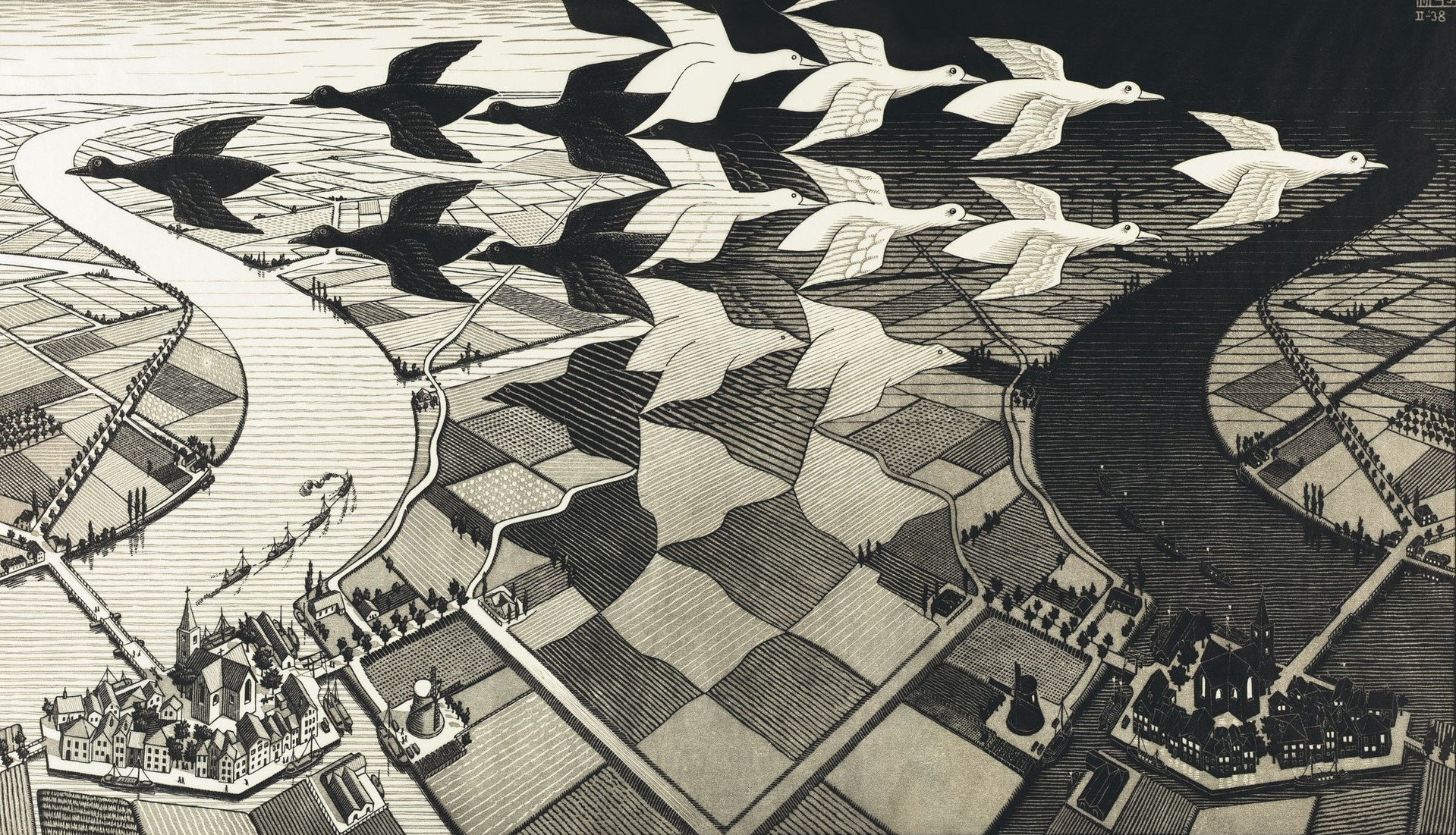
The spatial metaphor now begins to fail as well. We are accustomed to saying that the substrate “unfolds”, as though there were a point from which it spreads or a place in which it had previously lain folded. But if space itself arises as one mode of physical organisation, no privileged coordinate can be sought for the ground—not because there are infinitely many such coordinates, but because the very concept of a coordinate belongs to the next level of description. Escher’s recursive constructions—Drawing Hands, Ascending and Descending, Waterfall—remain useful metaphors: they offer the eye a structure in which no single beginning of the sequence can be identified without remainder. But this is a metaphor of centrelessness, not a model of the structure of the Universe.
The Gospel of John offers another image: “The Spirit breathes where it wills, and you hear its voice, but you do not know where it comes from or where it goes.” The Greek πνεῦμα (pneuma) retains the meanings of breath, wind and spirit; in Stoic philosophy, pneuma was also connected with an active principle, connectedness and the organisation of bodies. None of this, of course, licenses an inference to informational physics, still less to quantum non-locality. But the philosophical resonance is too expressive to ignore: action manifests locally without requiring a single localised centre; connectedness is disclosed through effects without revealing to the observer the place where its “headquarters” resides. The metaphor of breathing therefore proves unexpectedly apt as an image of transition: inhalation differs from exhalation, expansion from contraction, one state becomes the condition of another.
The informational substrate breathes where it wills. Not because it possesses will or intention, but because none of its particular configurations contains a final script for its own continuation. Breathing captures well what was earlier called the difference of differences: a difference does not merely exist; it changes the space of subsequent possibilities. Yet here too the metaphorical status of the language must be retained. The substrate does not “breathe” in a physical sense, does not choose the next configuration and possesses no hidden subject. On the contrary, the absence of such a subject is what matters now: order can arise without central order—without a single place, design or authority in which its final pattern would already exist in advance.
The evolutionary dynamics of viral populations provides an almost laboratory-like illustration of such organisation. A virus has no control centre, nervous system or subject capable of planning the future of a population. Mutations, recombinations, replication errors and other sources of variation create a multitude of local differences; environmental conditions, immune pressure, modes of transmission, random drift and natural selection confer unequal stability upon the resulting variants. Some disappear, others spread, still others become the material of subsequent changes. No final image of the virus exists in advance, and no external selector chooses it consciously. The global pattern arises from the interaction of local differences.
The virus matters here as an example of order without a conductor. A first difference—a new genetic configuration—changes the conditions under which subsequent differences can arise; the variants themselves then acquire different degrees of stability in a particular environment, and the sequence continues. Here it is especially clear that organisation need not be the result of a prior design. It may arise as the historical effect of repeated selection among configurations. This is neither a model of the informational substrate nor a biological proof of infodicy. It is only another rhyme: difference produces consequences, consequences alter the conditions of the next difference, and complex order can emerge without a central owner of the process.
Order is possible without central order. Logos articulates. Dao unfolds without a centre. Śūnyatā reveals the absence of self-being. The Spirit breathes where it wills
Carl Gustav Jung sought a wholly different instance of persistent patterning not in physics or in biological populations, but in the psyche. His concept of the archetype is often popularised as a set of ancient images somehow mysteriously transmitted from generation to generation, More relevant here is the fact that an archetype may be understood as a form or predisposition towards a particular mode of organising representations, rather than as a ready-made image with unchanging content. Here an unexpected affinity arises with the Gestalt-idea introduced earlier. The mother may assume the forms of Isis, the Virgin Mary, earth, cave, sea or house; the structural kinship lies not in the identity of these images, but in the capacity of different contents to be organised in similar ways.
Read in this way, the archetype is the stability not of a particular content, but of a way of distinguishing and relating content. It manifests itself through a plurality of non-identical embodiments. The recurrence of similar mythological and symbolic structures does not, of course, in itself require the hypothesis of a single informational substrate: shared human biology, similar life situations, cultural transmission and independent convergence can explain many such correspondences. What matters here is the stability of form amid radical variability of material. After the Gestalt-idea, it acquires an additional significance: the observer inherits not only information about the world, but certain ways in which the world can be partitioned, organised and assembled into recognisable wholes.
More speculative still is Jung’s notion of synchronicity—an “acausal connecting principle”—developed in part through his long intellectual dialogue with Wolfgang Pauli. The temptation here is particularly strong to invoke quantum entanglement immediately and declare it the physical mechanism of synchronicity. That cannot be done: quantum correlations are a defined physical phenomenon, whereas synchronicity is a hypothesis concerning meaningful coincidence between psychic and external events without an established causal connection between them. Nothing licenses us to turn one into experimental confirmation of the other. Yet the philosophical question is interesting in itself: must every structural affinity between two events be exhausted by a direct local causal chain available to the observer?
The dialogue between Jung and Pauli suggested the possibility of a broader monistic reading: the psychic and the physical need not be two wholly independent substances between which some mysterious channel of connection is required; they may be regarded as different manifestations of a more fundamental order—not necessarily a central order, and not presupposing a single subject to which that order belongs. For infodicy this is, once again, not confirmation but resonance. Within our working hypothesis we may ask whether two locally unconnected events can be different articulations of a deeper configuration. We have no physical basis for asserting that this is what actually occurs in cases Jung called synchronicity. Yet the question matters because it separates the problem of connectedness from the obligatory image of a signal sent from one event to another.
The collective unconscious, then, need not resemble a gigantic super-psyche hovering above individual minds. A more cautious reading allows us to speak of subjectivity without a subject: the persistence of certain modes of organising experience that precede the individual person and are actualised through that person without belonging to them entirely. Structures of distinction may be shared without presupposing a common subject to which they belong. Individual consciousness itself remains local; the forms through which it gathers the world into meaningful wholes may be immeasurably older than it and capable of outliving a particular observer. Here the archetype and the Gestalt-idea converge again—not as identical concepts, but as two ways of seeing the stability of form without the immutability of content.
There is no world-subject that thinks through us all, and no central order that reduces local acts of self-observation to a single design. There is a substrate within which local points of self-observation arise again and again, each distinguishing the world through configurations that came into being before it and may outlive it. The collective unconscious, on this reading, is not a common mind of humanity. It is the possibility of what is shared without a single owner—and of order without central order.
X. On the Threshold of a Big Bang of Another Kind
By this point, a fairly coherent picture has taken shape before us. We began with time as one of the conditions of distinguishability, passed through quantum entanglement and the hypothesis of the primacy of information, introduced the triad Information ↔ Void ↔ Chaos, encountered consciousness as a configuration in which difference becomes experienced, traced the persistence of modes of distinction in culture and living matter, admitted the mutability of the mode of perception itself, and finally attempted to imagine an order that requires no external demiurge. The informational substrate allowed these themes to be linked within a single language. We might have stopped here: a working ontology has been constructed, its concepts are connected, and the resulting picture is coherent enough to be developed further as a system.
This is where we must do the opposite—stop the system itself. Not in order to abandon it, but to return to a methodological remark that appeared near the beginning of the essay and was immediately hidden in parentheses: “Still, to use the phrase ‘informational substrate’ continuously is already to occupy a single point of entry—but more of that later.” That “later” has now arrived. The preceding argument proceeded as though the informational substrate were an object placed before a neutral observer and gradually disclosing its properties. We asked how it related to time, matter, consciousness, chaos and difference. We scarcely asked, however, from what position the very possibility of asking these questions in this form had arisen.
We have spoken of the informational substrate. We have spoken of fractality, emergence, quantum entanglement, cognitive configurations and the difference of differences. In each case, language appeared to be a transparent intermediary between observer and observed. But language never comes from nowhere. Behind it lie modes of classification, mathematisation and proof; ways of separating the essential from the accidental, signal from noise, cause from coincidence. The question must therefore now be posed differently: who, exactly, has been speaking all this time? From what position has this picture been unfolding before us?
We reason not merely as an abstract Homo sapiens. Our way of asking questions belongs to a particular historically formed civilisational and technological cadence—one line of European rationality that has passed through ancient philosophy, the mathematisation of nature, the scientific revolution and modern experimental physics. This line has produced an exceptionally powerful way of distinguishing reality: it allows us to construct testable models, predict events, create technologies and correct our own errors. Nothing in the argument that follows diminishes this power. Yet the success of a mode of distinction is not the same as proof that it exhausts all possible ways of drawing distinctions. The further we advance within one coherent picture, the harder it becomes to notice not its errors, but the fact that the very formulation of the question has already selected a particular class of possible answers.
The earlier formula of the “point of entry” now acquires an epistemological meaning for the first time. We are not yet speaking of a plurality of equally valid truths, nor of an observer’s arbitrary choice of reality according to taste. Different ways of making distinctions need not be equally precise, productive or testable. The question is more modest and, at the same time, more dangerous: might there exist stable configurations of experience in which relations become significant that remain virtually invisible from our own position? Might we enter so deeply into one self-consistent landscape that another way of unfolding it would be classified by us not as mistaken, but simply as meaningless?
The subject disappears. The structure of distinction remains
Before carrying this question directly into physics, it is worth turning to witnesses of a special kind. They do not conduct reproducible experiments and need not prove the existence of another ontology. Yet culture knows people whose work consists in destabilising familiar ways of distinguishing: shifting the boundary between essential and accidental, inner and outer, form and void, time and memory, possible and impossible. They need not know that this is what they are doing, still less formulate it in the language of informational ontology. Our humanistic tradition has given them a much simpler name: artists.
XI. The Artist on the Edge of Meaning
If all knowledge begins with some way of making distinctions, art is of particular interest to us not because the artist has access to a truer world. The artist possesses no privileged channel to reality mysteriously denied to the physicist, biologist or engineer. But artistic activity permits what stable cognitive practice ordinarily treats as a defect: shifting the boundaries of the essential and accidental, disrupting familiar hierarchies of features, joining incompatible scales, violating causal sequence, turning ground into figure and figure into ground. An artist need not prove the productivity of a new distinction through a reproducible experiment. It is enough to create a form within which another way of seeing can, for a time, be experienced.
A work of art may therefore be regarded as the material trace of a singular configuration of distinction. It arises in an individual consciousness, but ceases to be merely individual once it takes a form capable of being perceived by another. The artist works at the edge of meaning: far enough from the accepted organisation of experience for a genuinely different relation among things to emerge, but not so far that the very possibility of return disappears. Beyond that boundary, the experience remains incommunicable; on this side of it, it becomes a repetition of what is already known. The work arises between those limits—as an attempt to leave a sign in a place to which another person cannot be led by the hand.
Otar Iosseliani’s biography offers an almost symbolic example of a transition between two modes of organising experience: mathematical training and cinema. It would be excessive to describe his departure from a mathematical career as a conscious “ontological choice”, yet his cinema does indeed produce a different regime of attention. Causal plot ceases to command the frame unconditionally; an incidental gesture, the movement of an animal, a noise, an object at the periphery, a human habit acquires a right to exist without being subordinated to a single narrative centre. In Kafka, a comparable displacement takes another form: meaning does not vanish, but continually retreats behind the next authority, door or procedure. In Borges, by contrast, the problem arises from an excess of possible centres — a library may expand to the size of the Universe, a map not coincide with its territory, one story generates incompatible continuations. These worlds cannot be reduced to one another, yet each reveals how natural its own way of making distinctions appears while we remain within it.
Cinema is especially revealing because it can alter a configuration of distinction in time without warning the viewer of the moment of transition. In David Lynch’s Mulholland Drive, the coherence of the first part gradually discloses its own unreliability: characters, causal relations and identities are reorganised in such a way that the viewer must reconsider not a single event, but the very principle by which events had until then been assembled into reality. Parajanov produces a different shift: succession yields to ritual time, repetition, frontal composition and the object as sign, so that an event ceases to be merely a link in a narrative chain. Late Godard takes another step, exposing the act of distinction itself: through montage he collides image, text, voice, memory and history until the viewer can no longer forget that to look is to choose, and every choice leaves something unseen. These are not “other physics”. For the moment, they are only other ways of organising the experienced.
In painting, the same work takes place at the boundary between what is represented and the act of seeing itself. Kandinsky releases line and colour from the obligation to represent a recognisable object; Rothko weakens figuration to the point at which the principal event becomes the relation among colour fields, the scale of the painting and the presence of the viewer. Dalí, by contrast, does not abandon recognisable form but makes it unreliable: his paranoiac-critical method allows one visual material to organise itself into several incompatible images. In each case, what changes is not the substance of the world but which differences within it are granted the right to become primary. This is why art matters to our hypothesis not as an illustration of an ontology already complete. It demonstrates in practice that the same sensory material admits radically different ways of organising meaning.
In music this becomes clearer still, because distinction is enacted directly in time. In Cage’s 4′33″, silence is not literally turned into music; the frame is altered so that a listener’s cough, the movement of air, the creak of a chair and external noise cease automatically to be excluded from the field of musical attention. Schnittke builds polystylism upon the coexistence of languages, each carrying its own historical logic and refusing to dissolve completely into another. In his sonoristic works, Penderecki shifts attention from individual pitch to density, mass, cluster, timbre and the movement of sonic texture; this is why Threnody to the Victims of Hiroshima can be experienced almost bodily, although sound and pain do not, of course, become physically “one substrate”. The ECM aesthetic, meanwhile, makes the acoustic space between sounds a full participant in the musical event: silence here is not an absence of material, but a condition through which material acquires form.
Architecture makes the problem sharper still, because here a new distinction must withstand the resistance of actual matter, the body and gravity. In Frank Gehry, the familiar legibility of a building as a sum of walls, floors and façades gives way to the experience of colliding volumes and skins; in Zaha Hadid, horizontal and vertical, wall, floor and ceiling flow visually into one another. Physical gravity, of course, does not disappear—on the contrary, the engineered structure must obey it entirely—but architecture can organise bodily perception as though the familiar gravitational hierarchy of space had, for a moment, lost its self-evidence. In Calatrava, a static structure retains the memory of skeleton, wing, joint and tension. Here the distinction between physical law and Gestalt-idea becomes especially clear: the law does not change, but the way a person distinguishes support, movement, mass, equilibrium and void can be reorganised almost beyond recognition.
None of these artists moves towards a single secret knowledge. Their differences cannot be dissolved by declaring Kafka, Borges, Lynch, Parajanov, Cage or Rothko witnesses to one hidden ontology. Yet their irreducibility is what matters. Convergence is impossible in the sense that no final interpretation can turn Kafka’s inaccessibility of meaning into Borges’s multiplication of it, Parajanov’s ritual time into Lynch’s instability of identity, or Cage’s silence into Rothko’s colour field. Resonance, however, is possible: a work arising from one configuration of experience can disturb the stability of another. This is why the earlier metaphor of a gravitational lens is particularly apt: art does not transport the observer into another world, but it can bend the familiar trajectory of attention so far that one’s own world becomes, for a moment, visible from an angle that had previously been impossible.
In this limited sense, art at its most radical may be called ontological reconnaissance. Not because the artist investigates unknown regions of the informational substrate as an expedition investigates territory, and not because artistic intuition possesses the status of physical measurement. Reconnaissance here means reaching the boundary of one’s own system of distinctions and attempting to bring back a form from there. The artist is indeed alone in this movement, because no procedure can guarantee another person the same experience. But that solitude is not absolute: if return were impossible, no work would arise. A painting, film, piece of music, building or text exists because a private experience has found a structure capable of outliving its author and provoking in another person a shift that is not identical, but related.
Here lies an important boundary between artistic and scientific ways of dealing with the unknown. Science seeks to formulate conditions under which a result can in principle be reproduced by an independent observer; that is what makes its knowledge technologically cumulative and publicly testable. Art is under no obligation to turn the originating experience into a reproducible procedure. It preserves that experience as a trace of passage—not an instruction guaranteed to deliver us to the same point, but a form capable of disturbing the habitual configuration of another consciousness. The artist therefore does not so much “refuse to become a physicist” as accept a different contract with reality: no repeatability of the path is promised. From within this intellectual exile, the artist leaves signs by which another person may make not the same passage, but one of their own.
The vocabulary of ancient philosophy offers several images for such a transition, and it is useful not to conflate them. Platonic ἀνάμνησις (anamnēsis)—recollection—connects knowledge with a return to something that in some sense already belongs to the soul; Aristotelian ἀναγνώρισις (anagnōrisis)—recognition—designates the dramatic passage from ignorance to knowledge, when the previous configuration of events suddenly acquires a different meaning. For artistic experience, a third motif is also suggestive: that of immediate intellectual apprehension, a turning of the mind towards what is not reached through sequential reasoning. Plotinus does indeed contain the idea of such an immediate intellectual act and a turning towards the intelligible; the earlier ἐπιβολή (epibolē) is therefore best retained as a philosophical metaphor of an instantaneous “touch”, without turning it into a technical term for “direct informational contact” with the One.
Here the distinction matters. An artistic gesture may resemble anamnēsis when something is unexpectedly recognised as long familiar; anagnōrisis when one detail reorganises the meaning of the whole; or an instantaneous touch when a new configuration arises before the artist has time to give it a concept. But none of these modes proves the existence of “another physics”. They show only that consciousness can reach the limits of its habitual distinctions and return from there with a form.
A question now arises that art alone can no longer answer. As long as everything occurred within the space of experience, form and culture, one could speak of a plurality of perspectives without disturbing the unity of the physical world. Kafka and Borges may be ontologically irreducible as artistic worlds while remaining works created in one and the same Universe and governed by the same physical laws. But must only our ways of experiencing reality differ? Could another way of making distinctions become productive in our engagement with matter itself—generate a different sequence of observations, operations and technologies? Artistic reconnaissance ends here. The next, far more speculative question begins.
XII. Physics in the Plural
In the preceding section we reached the boundary at which art ceases to be a sufficient example. The artist can alter the configuration of experience, make space, time, causality or identity behave in unfamiliar ways, but it does not follow that another physics exists. Let us now take that step deliberately. What if not only different ways of perceiving one physical world are possible, but different physics—different systems of stable regularities discovered from different cognitive funnels? Not alternative descriptions of laws already known to us, nor cultural metaphors for one final picture, but physical paradigms, each beginning to unfold reality from its own initial distinction and, for that very reason, opening chains of regularities inaccessible to the other.
The hypothesis is deliberately speculative. We possess no experiment proving the existence of a second physical paradigm irreducible to our own, nor do we propose a system of equations competing with contemporary physics. Yet the absence of proof is not proof of impossibility. The history of science itself shows that a physical law does not lie before us carrying a label with its name. Something first occurs that an observer notices as differing from expectation; the observation is repeated, conditions are altered, stability is discovered, and the next experiment is constructed. Sometimes the first step is deliberate, sometimes chance assists it. In either case, physics begins before theory—at the moment when one difference first becomes stable enough to demand a further question.
A work is not a map of another reality. It is a trace of the moment when the familiar map ceased to be the only possible one
After the first successful distinction, the effect we have already called the cognitive funnel begins to operate. A successful experiment does more than report a new fact: it changes the probability of the next question. An instrument is built for the relation that has been detected; a procedure forms around the instrument; the procedure demands a new language; the language makes possible an experiment that previously would have occurred to no one. The next confirmation reinforces the first, the third reinforces the first two. Across centuries, a regularity noticed perhaps by accident grows into a self-consistent landscape of equations, measurements, technologies and assumptions about what in the physical world is worth distinguishing at all. The more productive such a paradigm becomes, the deeper it travels into its own funnel, and the more natural its initial distinctions begin to appear to the observer within it.
A stronger conjecture follows: this process need not end in convergence. The history of knowledge is usually narrated as though different paths of inquiry may wander for a long time but must ultimately meet in one final physics. Our hypothesis offers no such guarantee. Two sequences of distinction may diverge early enough for each subsequently to acquire its own experimental and technological productivity. Moreover, the more successful they become, the more difficult translation between them may prove. It is possible that two sufficiently divergent physical paradigms cannot be reduced to one another without destroying the primary distinctions by which each became workable in the first place. Convergence would then be not the summit of two paths, but the collapse of the very ways of travelling.
The strangeness of this thought must be taken seriously. We are accustomed to assuming that if two civilisations interact with the same physical world, the more advanced will sooner or later be able to understand the technology of the less advanced, since both are governed by the same laws of nature. But that assumption has already been made from inside our own physical funnel. Imagine the reverse case. A person from the early nineteenth century is given a modern microprocessor. They can see the material, measure its dimensions, examine the surface, pass an electric current through it—but the artefact itself does not contain the sequence of discoveries that made it possible. A fragment of silicon does not directly disclose the entire trajectory from electromagnetism and the study of the electron to the quantum theory of solids, the semiconductor junction, the transistor, the integrated circuit, photolithography and computer architecture. The artefact exists here and now. The path to it is not inscribed in the artefact itself.
The point is sharper still in biotechnology. Imagine the builder of an ancient megalithic complex placed in a modern synthetic-biology laboratory. They see materials, instruments, transparent vessels, liquids and screens—but between what they see and the procedure by which a minimal cell is constructed lies a chain of distinctions absent not only from their knowledge but from the very structure of their questions. Conversely, our technological superiority in the microscopic domain does not guarantee that we can reconstruct another sequence of operations from its macroscopic result alone. Symmetry matters more here than comparative “advancement”: the maker of a microchip may be as helpless before some vanished technological task as an ancient engineer would be before a microprocessor fabrication plant.
What may vanish from a technology is not only the device. The very sequence of distinctions by which the device once became possible may disappear: which property was noticed first, which accident proved reproducible, what second experiment followed the first, what counted as signal and what as noise, what relations among substance, geometry, movement and environment gradually cohered into a practically functioning system. What remains to descendants is the result—sometimes monstrously durable when made of stone—but not the question to which that result was an answer. And the further their own physical funnel has travelled in another direction, the less reason there is to expect that an increase in computational power alone will ever reconstruct the lost sequence.
The word “never” now ceases to be rhetorical exaggeration. If what has been lost is merely a recipe, the recipe may one day be reconstructed. But if an irreducible physical paradigm has disappeared, we may never understand the technological meaning of the object it left behind—not because we are insufficiently intelligent, but because every question we put to the object is already asked in the language of another physics. We can measure it, date it, describe its material, calculate its loads and propose physically possible methods for individual operations. None of this yet means that we have reconstructed the sequence of distinctions within which the object once became technologically natural.
An artefact may outlive not only the civilisation that created it. It may outlive the physics in which it was created
We can now turn directly to megaliths. They interest us not because they “prove antigravity”. The very word antigravity already belongs to our funnel: we see an enormous mass and immediately formulate the problem as the need to overcome gravitational force. But why assume that the original builder partitioned the task in this way? Archaeology and experimental archaeology can demonstrate the physical feasibility of many individual operations with stone using known mechanical means. That is important knowledge. Yet the possibility of dragging a block, lifting it with a lever or using an inclined plane is not identical with reconstructing an entire vanished technological cadence—from quarrying and working the material to the mass positioning of elements, organisation of the process and attainment of the required spatial precision.
What interests us is not one especially spectacular monument, but the recurrence of the megalithic intuition in different parts of the planet: the human persistence in working with masses of stone that, from the standpoint of later economic rationality, often appear almost absurd. We need not therefore declare every polygonal wall or enormous block evidence of an unknown force of nature. Yet neither need we assume in advance that every vanished technological logic must ultimately turn out to be merely a more elaborate combination of the operations that first occur to us. This is the trap of the cognitive funnel, testable within its own logic: what appears natural first is what previous success has already taught us to see.
At this point our hypothesis consciously diverges from accepted archaeological interpretation. Egyptology possesses a substantial body of evidence linking pyramid complexes to royal funerary cult: pyramids form ensembles with mortuary temples, causeways, surrounding burials and other elements of the corresponding culture. In Mesopotamia, ziggurats are likewise documented in connection with temple complexes and the religious life of cities. This is not a lacuna that can simply be declared an absence of explanation. Yet the format of our argument permits another question to be asked—as a hypothesis. Must the sacred function documented in the historical record be identical with the original technological genealogy of the form? Is it possible that some structures were inherited only after the system of distinctions within which their original meaning arose had already been lost, and were then incorporated into an entirely new semantics? We do not claim archaeological proof for such an origin. We propose a model of secondary sacralisation: a technologically unintelligible object outlives its physics, and the next culture is therefore compelled to give it meaning anew.
The analogy with a cargo cult is useful here—not as a disparaging characterisation of ancient people, but as a general model of the semantic inheritance of technology. If a society receives a material form whose productive context has vanished, it does not cease to interact with that form. On the contrary, the object’s durability, scale and unintelligibility demand explanation. A technological function may be replaced by a cosmological, royal, funerary or ritual one. The descendant does not simply “make a mistake”: a new, functioning system of meaning is created around a thing whose previous system of meaning has become inaccessible. The artefact continues to exist, but it now belongs to another cognitive funnel—and therefore begins to answer different questions.
We may therefore entertain—only as a hypothesis—that some forms later firmly incorporated into sacred systems may originally have belonged to the technological infrastructure of an earlier civilisational cadence. We do not know what exactly they did. And here it is essential not to invent the missing technology. The moment we say “generator”, “antigravity device”, “energy transmitter”, we once again forcibly translate an unknown physics into the language of our own. Greater consistency requires us to admit ignorance: if the original funnel has indeed disappeared, the name of the function may be as inaccessible to us as the operation of a modern microprocessor would be to someone equipped only with the concepts of early nineteenth-century mechanics.
For this reason, the earlier hypothesis of a first civilisational-technological cadence now requires correction not in the direction of greater caution, but of less specificity. In an earlier essay it was described through conjectures about “antigravity”, wireless energy transmission, the technological purpose of pyramids and the principled irreducibility of physical paradigms. The last of these remains the principal thesis here, while the concrete reconstructions become dispensable. The earlier text had already formulated the idea that each physical paradigm traces its own chains of regularity and may be “blind and deaf” to another; the present infodicy can now suggest why—through the cognitive funnel.
We can go further still. A vanished technology need not leave even the apparatus itself behind. Sometimes its effect is enough. Imagine a civilisation a thousand or several thousand years after the complete disappearance of nuclear physics, its technical documentation and the very concept of radioactivity. Almost nothing recognisable remains of a ruined reactor, yet certain materials and the surrounding territory continue to differ from their environment. A new observer registers the effect, but possesses neither the history of the accident, nor the concept of radioactive decay, nor the instrumental tradition within which the effect has an obvious place. For that observer, this is no longer a remnant of technology. It is a strangeness of the world itself.
This suggests a deliberately speculative question that we shall leave unanswered: how many observable anomalies are anomalies for us only because the sequence of distinctions within which they might once have been ordinary technological effects has disappeared? The question itself is enough. We need no catalogue of gravitational anomalies, UFOs or other mysteries, because any hasty identification would once again destroy the meaning of the hypothesis. We do not know what to look for. If we did, we would already be inside that physics. In the earlier essay the thought was formulated more directly: nothing might remain of the oldest devices themselves, while their inertial effects continued to manifest themselves in the material world. Here we preserve the idea as an open possibility, not as an explanation of any particular phenomenon.
Edward Leedskalnin’s Coral Castle is useful in this context because it belongs to the opposite temporal extreme: the twentieth century. Here we have a specific individual and an object he built. We know that Leedskalnin used mechanical means—tripods, chain hoists, pulleys and homemade tools; some of those tools survive. Even the complex’s celebrated details demonstrate not the suspension of mechanics but extraordinarily skilful uses of balance and leverage. Coral Castle is therefore not evidence of an unknown physics—and for that very reason it is more interesting to us.
A person may possess a practically productive sequence of actions while explaining incorrectly why it works. Leedskalnin wrote about magnetism and claimed knowledge of the secrets of ancient builders; we are under no obligation to accept his physical explanations. A different question matters: what order of distinctions allowed him in particular to turn a set of comparatively simple tools into a decades-long building practice that he did not leave behind as a fully reproducible technology? Perhaps there was no hidden force at all. Even then, however, the object reminds us how great the difference can be between a list of physical principles and the living technological sequence that binds those principles into a result. What Leedskalnin left behind was not a theory but a built object in Florida.
Leedskalnin’s case shows how difficult it is to reconstruct, from a result alone, the trajectory of distinctions that led to it. To describe the structural rather than historical side of such irreducibility, let us return to the metaphor of the fractal—without turning it into mathematical proof. The Mandelbrot set is generated by a single rule, yet local regions of its boundary reveal extraordinarily different landscapes under magnification. One generative rule does not imply uniformity of manifestation. Our hypothesis imagines the informational substrate more radically still: as a ground within which the number of potential differences need not be exhausted by a single sequence of their discovery. A cognitive funnel captures one chain and follows it ever deeper. Another may begin almost beside it—with a slight initial deviation—and, after millennia, end so far away that mutual translation no longer has operational meaning.
A vanished physics need not therefore appear to us as a set of false propositions. It may not appear as physics at all. Its traces may be classified as inconvenient archaeology, strange technology, accident, ritual excess, measurement error, an effect of unknown purpose—in other words, distributed among the categories of our own system of knowledge, none of which reconstructs the original whole. This is how the principled irreducibility of funnels might manifest itself: not as a loud contradiction between two theories, but as the absence of a category within which the second could be seen by the first as a coherent system at all.
Let us now undertake a deliberately risky and consciously anachronistic, but physically coherent, thought experiment designed to make the ontological difference between points of entry palpable. Imagine a medieval alchemist in the place of Henri Becquerel—not because the alchemist possesses the physics of the late nineteenth century, but because he does not. He has no atoms in the modern sense, no nucleus, electrons, neutrons, isotopes or radioactivity. He has only substances, weight, colour, heating, dissolution, precipitate, luminescence, smell, and the traces one substance can leave upon another. Suppose that among heavy minerals he encounters a natural uranium ore. By chemical operations entirely conceivable within alchemical practice, he obtains a uranium compound. And suppose—this is the only anachronistic concession we need—that by experiment he has already learned to produce a light-sensitive layer based on a silver compound: a substance altered by light. For the alchemist this is neither “photography” nor a physical detector. It is simply another property of matter: as one substance blackens in fire, another changes colour in solution, and a third precipitates, so this one changes under the action of light.
Then one day something happens analogous to what occurred in Becquerel’s laboratory in 1896. The alchemist leaves a uranium salt beside the light-sensitive layer, separating them by a barrier opaque to ordinary light. Light does not reach the silver compound—and yet a trace appears. He repeats the experiment in darkness. Again a trace. He varies the exposure time. He removes sunlight altogether. The effect persists. In actual history, it was the capacity of uranium salts spontaneously to emit penetrating radiation, recorded on a photographic plate without prior illumination, that led Becquerel to the discovery of a new phenomenon—natural radioactivity.
Our alchemist cannot call what has happened radioactivity. But this does not mean that he has discovered nothing. On the contrary, his empirical distinction is exact. Before him is a substance that, in darkness and without any visible alteration of itself, produces an effect beyond immediate contact; the effect passes where ordinary light cannot and reveals itself only through the alteration of another substance. What will he distinguish first? Perhaps he will call it hidden light. Perhaps inner fire. Perhaps he will suppose that certain metals contain an invisible “principle” capable of leaving the substance without being flame, heat or visible radiation. The name does not matter. What matters is that the first successful experiment has already set the direction of the next question. Becquerel asks within the conceptual space of late nineteenth-century physics. The alchemist asks within a conceptual space of qualities, principles, elements, transformations and affinities.
They confront a similar empirical difference—and begin to diverge before the first explanation. The alchemist continues his experiments. He becomes convinced that the effect requires neither burning nor prior illumination; that it belongs to the substance itself and does not disappear when the familiar external cause ceases. For our physics, this follows naturally from spontaneous nuclear transformations. For him, a far stranger thought arises: a substance can contain the source of an action within its own mode of existence. What begins here is not simply the “error of an ancient man” that future science will correct, but the phenomenon that concerns us in the cognitive funnel. The explanation may be wrong. The relation discovered remains real. The alchemist can repeat the experiment, obtain the trace, distinguish a substance possessing the unusual property from one that does not, and establish greater or lesser degrees of the effect. His ontology may appear fantastic to us—his practical distinction already works.
Our physical funnel took another route. Becquerel’s trace on the photographic plate entered a sequence of discoveries that led to the study of radioactivity, the structure of the atom and atomic nucleus, and later to the discovery of fission in heavy nuclei. It was established that the fission of certain nuclei releases energy and produces neutrons, some of which, under appropriate conditions, can induce further fissions. A chain reaction can arise: some events create the physical conditions for the next. At criticality such a sequence becomes self-sustaining; below criticality it dies away.
We can now bring the alchemist back—without dragging him to a reactor or forcing him to impersonate a twentieth-century physicist. We need only ask how the principle itself might appear to him if the consequences of his original discovery eventually allowed him empirically to distinguish two regimes: a process that dies away, and a process in which each event increases the possibility of the next. The alchemist already has a language of his own for this. He might call the boundary between them an evil measure. Up to a certain measure the inner principle of a substance acts but remains contained within it. In another configuration, the action begins to reproduce the conditions of its own continuation. Measure ceases to be merely quantitative—it changes the character of the process itself. What merely occurred begins to sustain its own continuation.
The modern physicist will see no “evil measure” here. They will speak of material composition, interaction probabilities, neutrons, neutron losses from the system, and the conditions under which a chain reaction can sustain itself. This description belongs to a physics of immense experimental and predictive power. The alchemical picture is not its scientifically equivalent alternative. But infodicy is not interested in a contest over which textbook is true. Its concern is different: one and the same observable transition may first be partitioned into different primary distinctions. For one observer, between a stable and an unstable nucleus, between a dying and a self-sustaining chain of interactions. For another, between a substance that contains its inner principle and a substance in which that principle has crossed the “evil measure” and begun to reproduce its own action. It is not only the answers that differ. What counts as the question differs.
And if our alchemist asks where the capacity for such strange action arose in an earthly mineral in the first place, the two physics diverge further still. Modern nuclear astrophysics locates the origin of uranium in extreme neutron-rich cosmic processes. The heaviest naturally occurring elements are formed under conditions of rapid neutron capture; likely astrophysical environments include neutron-star mergers and certain kinds of stellar catastrophe. Uranium in terrestrial rock literally contains, in a physical sense, the trace of processes that occurred long before the Earth came into being.
The alchemist speaks differently. For him, all metals already belong to a relation between the celestial and the terrestrial. The newly discovered property would therefore almost inevitably receive a cosmogonic interpretation: he sees a metal in which the celestial principle has not completely congealed into earthly form, a substance preserving within itself a remnant of the distant fire of its origin. His “hidden light” becomes the trace of an incomplete passage between worlds. From the standpoint of our physics, this is wrong. And yet an almost indecent structural rhyme appears. The modern physicist does indeed answer the alchemist: yes, the origin of these heavy nuclei is cosmic. Yes, the uranium atom in your hand carries the history of catastrophic processes that preceded the Solar System. No, there is no celestial fire inside it. But your thought that earthly matter preserves in its present structure a trace of an entirely different cosmic history has come unexpectedly closer to the truth than your conceptual apparatus ought to allow.
Two cosmogonies. A neutron-rich catastrophe and an unfinished descent of the celestial into the terrestrial. An unstable nucleus and the hidden fire of matter. They do not translate into one another and do not possess equal explanatory power. Yet both grew around the same original stubbornness of reality: a salt lying in darkness leaves a trace where, according to the observer’s previous experience, no action should occur at all. Difference arose before explanation. The funnels diverge already in the interval between the first astonishment and the next question.
From here the thought experiment gives way to the history of our own funnel. In less than half a century, between Becquerel’s photographic plate and the first nuclear explosion, our system of distinctions travelled an immense distance. The invisible action of uranium was incorporated into a new system of concepts, experiments and technologies. From it emerged knowledge of nuclear transformations and fission; from knowledge of fission, the possibility of a controlled chain reaction; and from the same domain of physics, the possibility of an extraordinarily rapid release of immense quantities of energy. The physical regularity itself contained neither a power station nor a bomb. The technological trajectories arose later—as different ways of continuing the difference that had been opened.
It is not only the answers that differ. What counts as the question differs
Physics in the plural now meets the ethics of difference. The atom is not evil. Uranium does not desire destruction. A neutron does not know what a city is. There is no moral category within a nuclear interaction. But it does not follow that all the configurations an observer can build from that interaction are axiologically equivalent. One configuration allows the process to release energy in such a way that new differences can continue to arise around it: heat, movement, electricity, work, new structures. Another organises the same fundamental possibilities of matter around the fastest possible destruction of already accumulated complexity—human bodies, buildings, infrastructures, archives, languages, biographies, relationships and future events that might have arisen from them.
The difference of differences now becomes especially important. Evil is not contained in the atom. It arises as an asymmetry between configurations: between one that leaves distinction the possibility of continuing, and another that radically diminishes the set of possible subsequent differences. Nuclear weapons offer an almost limiting human example of the latter configuration. They do not destroy the informational substrate or turn the Universe into absolute chaos. That would be a physically meaningless exaggeration. They do something much more specific and therefore more terrible: in an extraordinarily short time they irreversibly destroy an immense accumulation of locally achieved meaningful complexity—the very complexity that took history years, generations and millennia to create.
After the Trinity test of 16 July 1945, Robert Oppenheimer later recalled a line from the Bhagavad Gita: “Now I am become Death, the destroyer of worlds.” The word later matters: there is no need to turn the historical episode into a theatrical legend about a sentence spoken at the instant of the flash. Yet the formula he chose coincides almost frighteningly with our axiology. Destroyer of worlds—not because the physicist discovered an “evil law of nature”. The law remained indifferent. What became destructive was the configuration into which human distinction incorporated that law. A medieval alchemist and a modern physicist might have named uranium’s hidden action in radically different ways. They might have built irreducible pictures of the world around it. Yet before destroyed complexity the difference between their languages suddenly loses significance. The destruction of a possible future requires no translation. A nuclear explosion is not the “evil of matter”. It is a human configuration of distinction in which one of physics’ greatest discoveries becomes a technology for destroying subsequent differences. Different funnels, one ontological horror. For the destruction of difference as such requires no translation.
Perhaps the hypothesis of physics in the plural returns us here to its strangest consequence. If an entire technological cadence, together with its physical funnel, could once have disappeared, then we already possess a limiting example of what it means to lose not only objects but possible continuations of knowledge. Perhaps some ancient artefacts are merely mute remnants of such a disappearance. Perhaps our interpretation of them is entirely mistaken. Perhaps no earlier physics ever existed at all. The hypothesis remains a hypothesis. Yet our own civilisation already possesses means capable of turning the irreversible loss of a cognitive funnel from an archaeological fantasy into a project for the future. The criterion then is not the power of a physics, nor even its truth within the questions it poses. The most exact theory can generate a configuration that radically reduces the number of those who will be able to ask questions after us. The most advanced civilisational-technological cadence receives from its advancement no guarantee of continuation. If difference has a history, history can be broken off; if a physics has a cognitive funnel, the funnel can disappear together with the observers, instruments, language and sequence of questions that produced it.
This is why the question of physics in the plural ends somewhere other than we expected. We began with the audacious possibility that an ancient artefact might belong to a physics we shall never understand. But much closer to us lies another possibility: we ourselves may leave to the future artefacts of a physics whose sequence of distinctions it will no longer be able to reconstruct. If that ever happens, a future observer will likewise look at the remains of our civilisation from within its own cognitive funnel—classifying, explaining, attributing meaning and, perhaps, mistaking the trace of a technological action for an inexplicable property of the world itself. It will be doing exactly what, perhaps, we are doing now.
See continuation: Part II
The full text is available for download as a PDF on Academia.edu