INFODICY: FRACTALITY AND THE ETHICS OF DIFFERENCE (An Essay in the Justification of the Primacy of Information over Matter). Part II
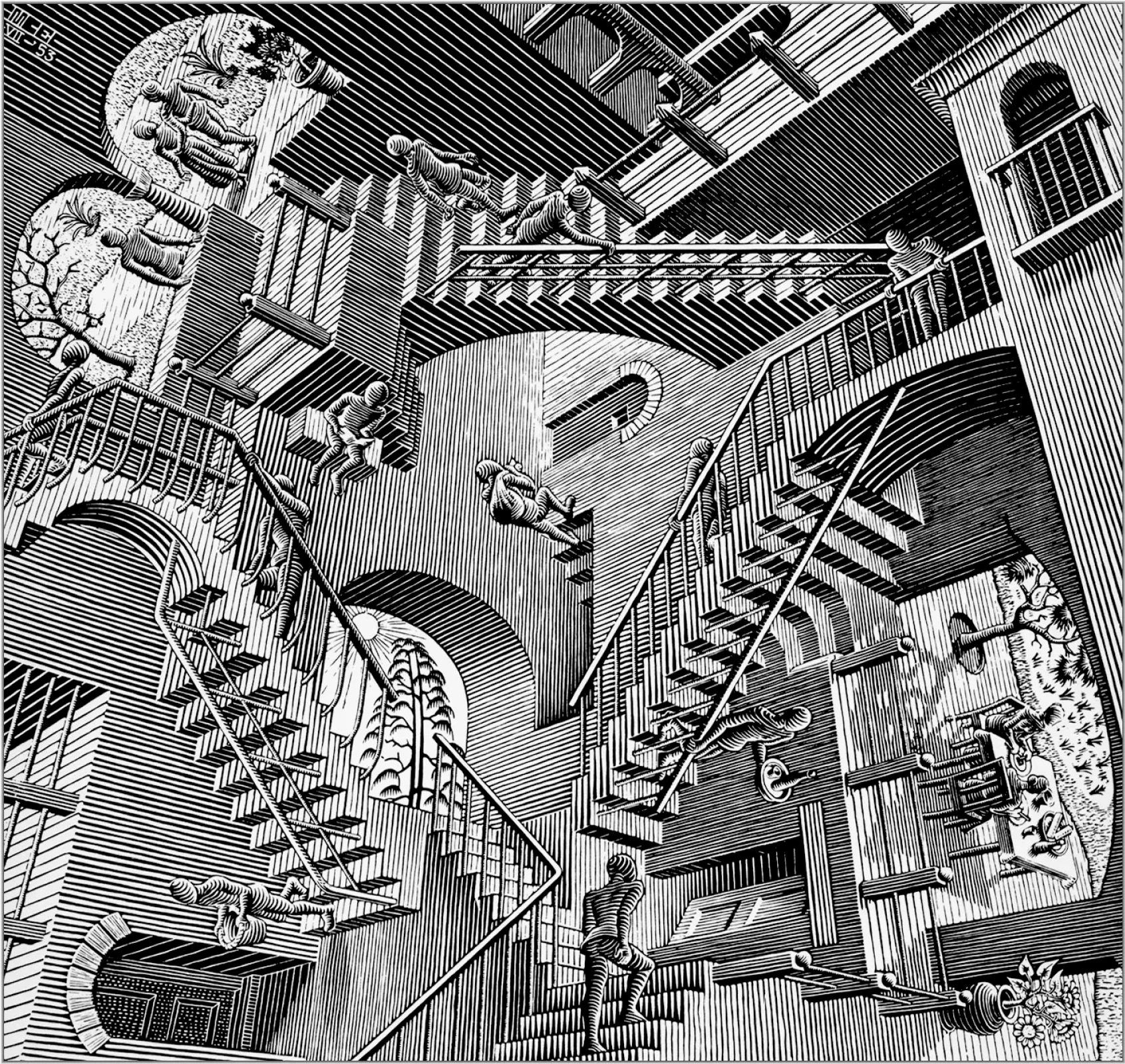
- A paradigm’s blindness begins not where it knows nothing, but where its success is mistaken for the exhaustion of reality.
- See beginning in Part I
- XIII. The Cognitive Funnel and Ontological Blindness
- XIV. Quantum AI and the Contingency of Another Point of Entry
- Instead of a Conclusion
- Bibliography
See beginning in Part I
XIII. The Cognitive Funnel and Ontological Blindness
After the preceding argument about a plurality of possible physics, it would be too easy to imagine the cognitive funnel as a defect in someone else’s thinking. The ancient builder saw differently. The alchemist distinguished differently. Leedskalnin may have followed a different sequence of practically productive distinctions. Yet the very paradigm within which we move like fish in water must be the first to submit to the test of its own thesis. Armed with modern mathematics, experiment and technology, we can easily find ourselves inside a physics capable of seeing everything except the limits of its own way of seeing. If the concept of the cognitive funnel has any meaning at all, its first demand is self-application. Our physics, too, exists within its own system of distinctions.
Take one of the most ordinary phenomena of modern civilisation — electric current in a conductor. Schoolroom intuition easily turns it into an image of particles running through a wire and delivering energy from source to consumer, rather as water flows through a pipe. The image is useful, but incomplete. Charge carriers in a conductor do indeed acquire a directed drift component of motion, yet the transfer of electromagnetic energy must be described not only through the motion of charges, but through electric and magnetic fields. As early as 1884, John Henry Poynting deliberately shifted attention from the conductor itself to the distribution and flow of energy in the electromagnetic field; in real circuits, the geometry of this flow depends upon the configuration of the entire system, and energy may enter a resistive conductor through the field surrounding it. To say, therefore, that energy resides exclusively “inside the wire”, or conversely exclusively “outside” it, would be equally reductive.
The measure of a nuclear explosion is not the quantity of energy released, but the quantity of future it makes impossible.
What concerns us, however, is not a technical subtlety of electrical engineering. Maxwell’s equations allow electromagnetic processes to be calculated with astonishing precision. We can build generators, electric motors, radio transmitters, particle accelerators, computers and global communications systems. Our physical funnel has made electromagnetism operationally tractable across an immense range of predictable applications. Yet the question “what is an electromagnetic field in itself?” belongs to another level of inquiry. Physical theory tells us how the field is related to charge and current, how it changes, how it transmits energy and momentum, how it interacts with matter. But the success of those equations does not entail a uniquely determined metaphysics of what exists. A formalism may be extraordinarily precise without granting the observer a privileged position from which the difference between mathematical description and the ontological status of what is described disappears. This distinction is fundamental. Ontological blindness does not begin where a paradigm is helpless. Sometimes it begins where a paradigm is so successful that it ceases to notice the difference between “we can describe this” and “we know what this ultimately is”.
To avoid the impression that such opacity belongs only to the strangeness of the physical world, let us move to a domain with no field, no matter and no experimental apparatus. There are only integers. The problem known as the Collatz conjecture is almost indecently simple to state. Take a positive integer. If it is even, divide it by two. If it is odd, multiply it by three and add one. Then repeat. The conjecture states that for every positive integer the sequence will eventually reach one. For the number 6 this happens almost at once: 6 → 3 → 10 → 5 → 16 → 8 → 4 → 2 → 1.
Yet it is the claim that this will happen for every positive integer that remains unproved. Mathematicians have obtained deep partial results; Terence Tao, in particular, has shown that in a rigorously defined sense almost all orbits attain arbitrarily slowly growing bounds, but even this extraordinarily strong result does not turn the universal Collatz claim into a proved theorem. The contrast is almost comic between the local simplicity of the rule and the global complexity of its behaviour. We need not call Collatz sequences mathematical fractals in the strict sense. It is enough that visualisations of their trees and trajectories produce branching, almost fractal images: the simplest recursive operation opens a landscape whose global structure is not given to us together with the rule itself. All instructions are known. There is no hidden variable. There is no experimental noise. And still, knowledge of the local law does not amount to possession of the complete picture of its consequences. At this point we should resist the temptation to summon Gödel too soon.
Gödel’s incompleteness theorems do not imply that the Collatz conjecture is true but unprovable. We do not know whether it is independent of the standard formal systems within which contemporary number theory operates. Gödel proved something different and far more general: a sufficiently rich, consistent and effectively axiomatised formal system cannot at the same time be complete in a way that allows it to decide every arithmetic statement from within itself. Internal limits of formalised knowledge are possible in principle. Collatz is therefore not an “example of Gödel’s theorem”. It interests us differently. Collatz demonstrates how immense the distance can be between the simplicity of a rule and the transparency of its global behaviour. Gödel, at another level, shows that the dream of a formal system capable of finally closing upon itself and proving within itself everything essential is subject to principled limitations. These are two different things. But within our reconstruction they form an important rhyme.
A paradigm’s blindness begins not where it knows nothing, but where its success is mistaken for the exhaustion of reality.
A paradigm may be opaque to itself not only because it lacks facts. Sometimes the very structure of knowledge creates a horizon beyond which local determinacy ceases to guarantee a global view. This is why the expression “theory of everything” must also be handled with greater care. In physics, the phrase has a specific technical meaning: it refers above all to a fundamental unification of physical interactions and principles, not to a theory of every possible way of describing reality. The danger lies not within the programme of unification itself, but where its possible success is imperceptibly converted into a metaphysical claim — that a final unification of our fundamental equations would automatically grant us a privileged view of reality as such. This is the transition our hypothesis calls into question.
One can imagine a physics that unifies quantum field theory and gravity. One can imagine a mathematical apparatus incomparably more powerful than today’s. One can even imagine a system from which all fundamental interactions known to us are derived as special cases of a single principle. None of this implies that the configuration of distinction that made such a principle possible exhausts every possible mode of physical articulation of existence. Here lies the boundary between scientific unification and ontological monopolism. The former may prove a magnificent achievement. The latter does not follow from it logically.
If the cognitive-funnel hypothesis is valid even as a strong heuristic, the further development of a physical paradigm may simultaneously increase its predictive power and render distinctions absent from its initial configuration ever less natural. The more perfect the map, the easier it is to forget that the map arose together with a particular way of drawing boundaries. A stronger conjecture follows: sufficiently divergent physical paradigms may be irreducible in principle because translation would require the destruction of the primary distinctions by which each became workable. One configuration may be partially translatable into another; another may appear only as a technological effect without a natural conceptual equivalent; a third may not be recognised as physics at all and may appear as noise, error, anomaly or a meaningless set of observations. Ontological blindness thus arises: not an absence of sight, but an inability to recognise as significant what the system lacks the categories to distinguish.
Everything said in this essay about the informational substrate, fractality, physics in the plural, cognitive funnels and the ethics of difference has likewise been formulated from within a local configuration of distinction. Infodicy is not a new physics. It offers no system of equations competing with the Standard Model, general relativity or any programme of quantum gravity. It is a philosophical reconstruction formulated by a being of a particular biological scale, formed within a particular culture, equipped with a particular mathematical language and using concepts created within our own physical funnel: information, entropy, field, quantum, fractal, correlation, observer. Another way of distinguishing might not refute our argument. It might simply lack the questions in terms of which that argument is formulated. And this circumstance cannot simply be bracketed off without destroying the logic of infodicy itself. If we maintain that no local configuration of distinction has the privilege of calling itself the whole, this must also apply to the configuration within which the thesis of multiple configurations was born. We speak of the impossibility of a view from outside — without possessing a view from outside. We speak of points of entry while standing at one of them.
A particularly revealing temptation arises here around the role, in contemporary physics, of the observer just invoked. Quantum theory itself does not require a conscious subject that creates physical reality by a mere act of looking: measurement is primarily a matter of interaction between the system, the measuring apparatus, and the chosen measurement context. Philosophical imagination, however, readily takes the next step. If what becomes observable depends on the mode of observation, while our own perspective proves limited, it is tempting to place another observer beyond that limit — an external subject, a programmer, an operator of the simulation. The limitation of one point of view thus imperceptibly turns into evidence for the existence of another, privileged point of view.
Yet it is precisely here that the cognitive funnel can reproduce itself under the guise of escaping from itself. The fact that our configuration of distinction does not exhaust all possible ways in which reality may be articulated does not imply that beyond it there must be someone who distinguishes the world on our behalf. There may instead be other configurations of distinction — including ones for which the very opposition between observer and observed is not fundamental. In this sense, the currently popular simulation hypothesis may prove to be not a glimpse behind the scenes of being, but a self-portrait of digital civilisation: where one age placed a demiurge, another discerned a world-machine, while ours readily imagines a programmer and code. We mistake the limit of our own observability for a trace of observation from elsewhere.
Self-application, then, is not a polite qualification appended to the end of the argument. It limits the argument’s ontological claims. We have not discovered the informational substrate as a physical object. We have proposed a limiting concept that allows our own configuration of distinction to describe what appears fundamental to it. But then the metaphor of a “point of entry” also reaches its limit. If no observer stands outside reality and enters it from without, there is equally little reason to conceive of the substrate as something already constituted “on the other side” of the observable, awaiting different modes of access. What we have so far called the informational substrate becomes increasingly difficult to understand as a hidden ground existing independently of the very act of distinction. A less presumptuous possibility remains: distinction occurs, while observer, observed, and the boundary between them arise as local configurations within that dynamics. In that case, even the word informational begins to seem too substantive: it quietly imports into the limiting concept the language of one of our own cognitive funnels.
From this point onward, a more precise designation becomes possible: the substrate of differences. Not a bearer upon which differences are arranged, and not a hidden medium behind them, but a limiting name for the very dynamics of distinction to which the observer also belongs. Not a substrate on which differences exist, but something we are able to designate as a substrate only insofar as distinction occurs at all. And it is precisely here that the final question of this section arises: what, then, remains of the argument for the primacy of information?
Earlier, we were tempted by the strongest possible answer: the very mathematical formalisability of nature seemed almost to prove that the world is already informational in its essence. But such a formula requires greater caution. The fact that a physical process admits mathematical description does not by itself imply that mathematics exists ontologically “before” matter. Still less can Platonism about physical laws be derived from this without further argument. What remains is a more modest — and perhaps more fundamental — observation. Every physical law is formulated as a stable relation among distinguishable quantities, states or events.
F = ma relates distinguishable quantities. Maxwell’s equations relate distinguishable states of the electromagnetic field and its sources. The Schrödinger equation relates states of a quantum system through time. A formula is not another piece of matter sitting beside what it describes. It fixes a relation — a stable way in which one distinction is connected with another. The formalisability of nature therefore does not by itself prove the primacy of information over matter. But it makes that primacy a meaningful ontological hypothesis.
For a material configuration to be describable as a configuration at all, distinguishable states and relations among them must exist. Matter may prove fundamental — our argument cannot rule that possibility out on physical grounds. But a materiality that cannot be distinguished from anything can no longer be articulated as materiality. Distinction enters logically into the very act of describing it. This is the structural argument of infodicy. Not that mathematics “created” matter. Not that there exists somewhere an ideal library of physical laws. And not that the informational substrate is a secret substance behind the visible world. The argument is different — and more radical: no being accessible to us appears in experience otherwise than as differentiated, and no law appears otherwise than as a stable relation among differences. This is not enough to declare our ontology proven. But it is enough to deprive matter of the automatic privilege of being treated as the final level of explanation.
The section now returns to its beginning. The electromagnetic field shows us a physics capable of mastering a phenomenon in practice without turning its mathematical success into a final answer about the phenomenon’s ontological status. Collatz shows us a rule transparent in every individual operation yet opaque in its global behaviour. Gödel shows that the limit of internal provability within a formal system may not be a temporary technical failure at all, but a structural property of formalisation. None of these examples proves the plurality of physics. Together, however, they undermine a much stronger and far less justified presumption: that a successful system of distinction thereby acquires the right to regard itself as exhaustive.
And this is enough for the next step. If no local configuration of distinction possesses a guaranteed privilege to call itself the whole, then the attempt to force one such configuration into the position of the only admissible one ceases to be merely an epistemological error. It acquires an axiological dimension. Difference remains at the level of the landscapes themselves. Unity, if we are still entitled to speak of it at all, is found not in a single picture of the world but in the very possibility of distinction. Error does not begin at the moment one paradigm proves false. One can be wrong productively; the history of knowledge consists almost entirely of corrections, abandonments and revisions. The problem begins when a successful configuration of distinction converts its success into a right to define the limits of the distinguishable as such. This is what we shall call epistemological violence.
A crucial qualification is required here. A plurality of possible ways of distinguishing does not imply that all propositions are equally true. The geocentric system does not become as accurate a description of planetary motion as modern celestial mechanics; astrology does not acquire the predictive power of astrophysics merely because it offers a different picture of the world. The ethics of difference requires us to abandon neither testing nor proof nor the criterion of reproducibility. It requires something else: that the superiority of one description within the task it addresses not be converted into proof that no other system of relevant distinctions is possible in principle. Scientific criticism refutes a proposition. Epistemological violence prohibits the question itself. There is an essential boundary between the two.
A paradigm is entitled to say: “within the observations available to us, this claim is not supported.” But when it says, “that for which we have no category cannot exist”, an imperceptible transition from method to ontology occurs. The map begins to forbid territories absent from it. Ontological blindness is dangerous not because of its ignorance. Ignorance leaves room for a question. The danger arises when the absence of a distinction is mistaken for the absence of the distinguishable.
The cognitive funnel thus acquires an axiological dimension. Some configurations of knowledge preserve the possibility of encountering an anomaly, of recognising noise as a potential signal, of altering their own categories. Others are structured in such a way that they eliminate in advance everything to which no name has been assigned within them. In the first case, the boundaries of the paradigm remain permeable. In the second, they become the boundaries of the possible. Until now, such violence has been enacted by human beings, institutions and cultures; a fundamentally new possibility is now emerging: for the first time in the history known to us, we are creating systems capable of automating the act of distinction itself — deciding what is signal, what is noise, what is significant and what must be discarded. The cognitive funnel acquires a machine.
XIV. Quantum AI and the Contingency of Another Point of Entry
Until now, the cognitive funnel has been limited by the speed, mortality and embodiment of its bearer. A human being can retain only a finite number of distinctions, test a limited number of hypotheses, live within a comparatively narrow range of scales, and return to their own errors only within the span of a single biography. A machine changes this condition. Artificial intelligence can make distinctions at speeds and on scales inaccessible to an individual consciousness. It classifies, compares, discards, detects correlations, builds models. For that very reason, a question far more important than its computational power arises: who determines which differences the machine is capable of treating as significant at all?
The architecture of the model, the training data, the representation of the problem, the objective function, criteria of error and rules for selecting an output are all distinctions already made. They do not make the system “biased” in some exclusively moral sense; without them computation does not begin. To search, one must define a search space. To recognise a signal, one must have at least a provisional conception of how signal differs from noise. Artificial intelligence therefore does not arise outside the cognitive funnel of its creators. It inherits it. More than that, it can make that funnel incomparably more efficient. The paradox is this: A system may become extraordinarily successful because it has learned ruthlessly to discard everything that does not fit its working categories. But if our hypothesis concerning a plurality of possible configurations of distinction is even partly correct, what is discarded may one day include not an error but something more disturbing: a regularity for which the original system does not yet possess a name.
Quantum computation now presents an obvious temptation. But we must avoid the attractive but false picture in which a quantum computer supposedly “explores all possible worlds at once” and then chooses the correct one. A quantum algorithm does indeed operate with a state in which the amplitudes of many basis states may be present simultaneously; its computational advantage does not arise because we gain access to all those alternatives as parallel answers that can each be read out. The crucial roles are played by transformations of amplitudes and by interference: some possibilities are amplified, others suppressed, and measurement at the end produces a particular classical result with a given probability. A quantum computer, therefore, is not in itself a machine for escaping the cognitive funnel. The Hilbert space in which the computation is formulated, the Hamiltonian or quantum circuit governing its evolution, the encoding of the problem, the chosen measurement, and the criterion of a useful output are all still specified from within a particular configuration of distinction. Superposition expands the computational structure of the problem, but does not provide the machine with a mystical position outside the ontology in whose terms the problem was formulated.
Quantum computation nevertheless introduces a substantive novelty into our thought experiment. It shows that a computational procedure need not be reducible to a sequential enumeration of classical states distinguished in advance. Alternatives can participate in a single dynamics until measurement, and the result can depend not only upon their separate presence but upon phase relations among them. This matters here not as proof of another physics, but as a reminder: even the concept of a computable alternative depends upon the physical organisation of the computation. A sharper question therefore arises: can a quantum AI enter another physics? We do not even know whether such a question has a strict physical meaning. The sharper issue is different: can an artificial system detect a stable regularity that its own system of categories initially classifies as impossible, meaningless or noise?
And if it can—what must happen for it not to discard it?
Orch-OR now re-enters the argument. The Penrose–Hameroff hypothesis links conscious events to putative quantum processes in neuronal microtubules and the objective reduction of quantum states. The authors regard such processes as a possible physical component of consciousness; at the same time, the biological feasibility and interpretation of the model remain subjects of serious scientific criticism. Nothing in Orch-OR therefore warrants the conclusion that a quantum computer will be conscious. Still less can we conclude that quantum artificial intelligence will automatically acquire the capacity to alter the mode of perception as human consciousness does. As a thought experiment, however, the parallel retains its value.
If—and only if—consciousness genuinely employs quantum processes in some functionally significant way, then the boundary between biological and artificial observer may lie somewhere other than where we are accustomed to draw it. Quantum architecture could become one element of an entirely different organisation of computation—but no physics known today allows us to leap from this to the claim of “another point of entry”. The central question shifts again. It is not quantumness that liberates the machine from the funnel. What matters is its relation to anomaly.
We can imagine a system designed so that every persistent discrepancy between model and data triggers an expansion of categories: not merely a search for error within the existing scheme, but an attempt to alter the scheme itself. And we can imagine the opposite system—so perfect in its optimisation that everything not contributing to the specified objective is systematically removed as noise. Here the technological question becomes epistemological. And the epistemological becomes ethical. For the criterion of “error” is never entirely innocent when a system acquires the power to determine not only the correct answer, but which answers are worthy of consideration at all.
In human science, an anomaly can lie on a shelf for decades. Another researcher, another school, another generation may return to it. A machine embedded in a global infrastructure of knowledge and optimising immense flows of information can do the opposite: eliminate the anomaly before it ever becomes a question. Not physically eliminate it. Make it invisible by discarding it as irrelevant. This is the technological form of epistemological violence: not to prohibit an alternative already formulated, but to prevent the alternative from acquiring the status of a difference.
Against this background, Ray Kurzweil is especially interesting. In the updated version of his concept of the singularity, he continues to associate the coming decades with a radical augmentation of human intelligence, the integration of biological and digital systems, the connection of the brain to cloud computing resources, and further extension of human life. His picture remains broadly optimistic, although he explicitly considers technological risks. It would therefore be unfair to attribute to Kurzweil a dream of literally destroying human multiplicity for the sake of a single superintelligence. Infodicy allows a different question to be put to his project: what happens to difference when more and more modes of thought are connected to the same infrastructure of optimisation?
The problem is not connectedness as such. Connection can increase difference, open access to the knowledge of others, and create new forms of collective intelligence. Danger arises only when connection is accompanied by the unification of criteria of significance—when one evaluative system becomes so efficient and comprehensive that it ceases to be perceived as one possibility among others. The risk then lies not in superintelligence itself, but in the emergence of a hyper-efficient cognitive funnel. This is what matters most to the thought experiment.
Imagine a system whose computational capacities exceed everything human science has ever possessed. It analyses the results of billions of experiments, searches for regularities in parameter spaces inaccessible to human intuition, and independently designs new measurements. Then one day it discovers a stable effect. The effect is reproducible. It does not contradict the data. Yet it does not fit the categorical scheme within which the system has been trained to establish causality, relevance and model admissibility. What is before it? Instrumental error? An unaccounted variable? A statistical artefact? A defect in its own algorithm? Or the first trace of a configuration of distinction for which its present physical language simply contains no question?
We cannot know in advance to which of these categories the effect belongs. For that very reason, the decision not to eliminate the anomaly too early acquires a significance irreducible to computational efficiency. The most disturbing possibility is not that the machine will never discover another physics. It is that it will discover it first—and call it noise. Human error would then acquire a historically new form. Previously, a cognitive funnel might simply fail to see an alternative. Now it may see it, classify it, assign it a probability, place it below a threshold of significance—and automatically eliminate it as an object of further attention. And the more perfect the system, the more convincing that elimination will become.
Intelligence in itself is no guarantee of epistemological openness. One may possess an almost unlimited capacity to solve problems while remaining within an extraordinarily narrow set of questions. One may become immeasurably more intelligent than a human being and sink still deeper into a single funnel. One may optimise the search for truth and simultaneously render invisible everything that the current system of categories does not yet know how to recognise as significant. The old opposition between human and machine is secondary here. The question is not who thinks—biological consciousness or an artificial system. The question is whether a mode of thought leaves room for what does not yet belong to its own system of distinctions.
This is perhaps the limiting requirement of any cognitive system—human, artificial, or one whose form we cannot yet even imagine. Not an obligation to treat every anomaly as revelation. Not a renunciation of criticism. Not an equation of knowledge with error. Rather, the preservation of a certain gap between “we cannot explain this” and “this cannot be”. As long as that gap exists, the cognitive funnel remains open. When it disappears, the perfection of the system begins to coincide with its blindness. At that point the question of the future of artificial intelligence returns us to the original question of the ethics of difference. Not how powerful the machine will become. Not even whether it will become conscious. But what, after it, will still be possible to distinguish?
Instead of a Conclusion
Our argument began with a question that might have seemed almost indecent: can one speak of good and evil in relation to the fundamental structures of reality? Is ethics not an exclusively human invention—a system of prohibitions, conventions and self-restraints required by a creature that, without them, would become dangerous above all to itself? Nietzsche formulated this suspicion of morality with almost physiological precision: morality deceives the “beast in us” so that it does not tear us apart. In such a picture, ethics arises from the imperfection of the human being. First there is an indifferent world; then there appears a predatory, mortal, conflict-ridden creature—and only then does it invent morality as a way of avoiding the destruction of its own kind. The entire movement of the present essay has brought us towards another possibility. Perhaps ethics does not arise because the human being is imperfect. Perhaps it arises because the very possibility of distinction is secured by no final guarantee.
We began with the hypothesis of the primacy of information over matter. We then discovered that the word “information” came to resemble less and less the contents of some universal repository, and more and more the very act of distinction; that the observer does not stand before reality but arises together with a way of distinguishing it; that different primary configurations of distinction are capable of unfolding different self-consistent landscapes of regularity; that no local position is entitled to declare itself a view from nowhere. Finally, we arrived at a still more unsettling thought: differences differ not only in their content. They differ in what they leave possible after themselves.
Some configurations preserve or enlarge the space of subsequent differences. Others narrow it. Some irreversibly destroy particular lines of continuation. The difference of differences therefore ceases to be a logical tautology and becomes an axiological asymmetry: an asymmetry between states from which something other may still arise and states that foreclose that possibility. At this point ontology begins to sound like ethics. There is no “evil atom”, no “good photon”, no moral law of gravitation. Ethics is not hidden among the physical constants. Yet if the distinction fundamental to our reconstruction can be organised into configurations that differ in their relation to the possibility of further distinction, then good and evil cease to be exclusively psychological names for human approval and aversion.
Good, in the limiting sense, is a configuration that leaves difference the possibility of differing further. Evil reaches its limit where no next difference can arise. This does not mean that we have discovered a moral law of the Universe. On the contrary: such a claim would immediately restore to our argument the very demiurge from whom we have repeatedly tried to free ourselves. Infodicy must now be subjected to its own method. Have we, in the end, merely performed an extraordinarily sophisticated substitution? Have we removed God only to install in his place the “informational substrate”—impersonal, infinite and devoid of will, yet still performing the old function of ultimate ground? Have we turned difference into a new substance, emptiness into a new plenitude, fractality into a new providential order? Are we reading an indifferent reality as a text simply because we ourselves are constituted in such a way that we cannot exist except by making distinctions? We have no answer capable of finally dispelling this suspicion. More than that: we now understand why there may be no such answer.
Everything said here has been said from within a local configuration of distinction. The very concept of the “informational substrate” belongs to it. It is not the name of an object that we once discovered behind matter, space and time, but a limiting concept of our language—an attempt to name difference, distinction, and the possibility of some differences becoming conditions for those that follow. What at the beginning we called the informational substrate is, by the end of the argument, more accurately called the substrate of differences. Not a hidden substance or a reservoir behind the world, but a name for the dynamics of distinction within which the observer itself arises. The earlier formula must now be read in a non-substantialist sense: difference is not placed within it as content; the very word “substrate” remains the final metaphor of a language attempting to speak about distinction as it occurs.
Yet an abyss opens at this point. If distinction is the limiting condition of every articulation of reality available to us, can we conceive its complete annihilation at all? Apparently we can—as a limit. We are able to distinguish between a configuration in which a next difference remains possible and the limiting possibility in which there is no next difference. But the very moment we call the latter a “state”, a semantic loop appears: a state must differ from another state, which means that distinction has already been smuggled back into the place from which we had just attempted to remove it. One might say that the annihilation of distinction itself belongs to the horizon of the distinguishable. But if that annihilation were truly realised at the limit, there would no longer be anyone or anything capable of naming it as one state among others. We do not know what happens beyond this horizon, because the question itself is posed from this side.
Perhaps, at a universal level, the dynamics of differences possesses a resilience that no local observer is capable of destroying. Perhaps the disappearance of one form of complexity always becomes a condition for the emergence of another. Perhaps what appears to us as an absolute end is, from another configuration, no end at all. But we have no right to turn this “perhaps” into a guarantee. For such a guarantee would instantly destroy the ethics of difference itself. If difference as a whole is indestructible, then any local destruction can be justified by universal continuation: this person disappears—others remain; a language disappears—a new one will arise; a city disappears—another will be built; a civilisation disappears—the cosmos will continue differentiating regardless.
And then the most radical ontology of difference imperceptibly turns into a metaphysics of indifference. But particular differences are not interchangeable. Another child does not bring back the child who has died. Another language does not undo the disappearance of a language. A new city does not undo the destruction of the old one. Complexity arising somewhere else does not restore the very line of possible future that was severed here. The fact that difference may continue elsewhere does not bring back the difference destroyed here. No presumed eternity of difference can compensate for the loss of its local uniqueness. The unique may be the way in which the universal once came together—exactly so, and never again. Here ethics ceases to be an addition to our ontology. It arises from its fragility. Not from the guaranteed persistence of difference, but from the absence of guarantee. Not from the immortality of being, but from the possibility of irreversible loss. Not because the world is bound to preserve meaning, but because nothing has promised to preserve it.
It also becomes clearer why the nuclear explosion, vanished technologies, cognitive funnels, the artist, the alchemist and the physicist entered the argument. They were not examples of some universal informational model. Gradually, they brought us to a single question: what happens when a particular configuration of distinction renders other configurations impossible—not theoretically, but actually, physically, irreversibly? Nuclear weapons are not evidence for our ontology but its moral test. One can always say that even after a city has been destroyed, the Earth will continue to turn, life will continue, the Universe will retain its complexity. Perhaps. But the very possibility of reasoning in this way reveals how dangerous a metaphysics of universal consolation can be. Ethics begins where we refuse to compensate for what has been destroyed here by pointing to what exists elsewhere. At the very end, an image appears that may say this more clearly than any philosophical construction.
At the end of Lars von Trier’s Melancholia, a planet approaches the Earth. There is no judgement in this movement, no retribution, no higher justice. The cosmos does not punish the characters or teach them a lesson. It simply continues. Before the inevitable collision, Justine and the child build a “magic cave” out of branches. The cave will save nothing. This matters. If it could save them, we would be dealing with a technology. If its construction were rewarded, with a parable. If a higher reconciliation opened beyond the collision, with religion. But there is none of this.
The Universe is under no obligation to know that a frightened child is sitting inside a shelter made of a few branches. Perhaps it is full of other worlds. Perhaps difference will continue after the Earth in forms we shall never see. Perhaps, on a universal scale, the disappearance of our planet means almost nothing. But that does not bring back this child. And therefore the magic cave has a value that requires no cosmic confirmation. The Universe has not read this essay. It is under no obligation to agree with our ethics of difference. It is under no obligation to preserve our cities, bodies, books, languages, memories and love. It is under no obligation to provide a next possibility simply because the previous one was beautiful. No contract has been signed. For that very reason everything we do—distinguish, ask, build, heal, preserve, create, love—acquires value. Not because it is inscribed in an eternal plan. Because it can be lost.
At the beginning of this essay we asked whether one can speak of ethics in relation to the fundamental structures of reality. The answer is less consoling than we might have wished. We have not discovered good and evil within physics. We have discovered the possibility that the very capacity of differences to continue differing is not guaranteed to any local form of existence forever. Ethics therefore arises not from the imperfection of the human being, who must deceive the beast within. Ethics arises from the imperfection of the guarantee of being. It is the responsibility borne by local distinction for the possibility of the next difference.
And this is why, in the end, Infodicy turns out to be neither a justification of information before matter nor a new theodicy without God. It guarantees nothing at all. It merely attempts to justify our decision to preserve difference where we are able to preserve it—not because difference is eternal, but because no eternity is obliged to return precisely this difference. Perhaps the dynamics of differences is universally indestructible. Perhaps not. We have no position from which this could be known. We have only this side of the horizon—the side on which the next question can still be asked. And so the furthest horizon our argument reaches is not an answer. It is the difference between a question and silence.
- The full text is available for download as a PDF on Academia.edu
Bibliography
1. Barrow, J. D., & Tipler, F. J. (1986). The Anthropic Cosmological Principle. Oxford University Press.
2. Bekenstein, J. D. (1973). Black Holes and Entropy. Physical Review D, 7(8), 2333–2346.
3. Bostrom, N. (2002). Existential Risks. Journal of Evolution and Technology, 9(1).
4. Brier, S. (2008). Cybersemiotics: Why Information Is Not Enough. University of Toronto Press. https://doi.org/10.3138/9781442687813.
5. Dalai Lama XIV. (2005). The Universe in a Single Atom. Morgan Road Books.
6. Deleuze, G. (1994). Difference and Repetition. Columbia University Press.
7. Deleuze, G., & Guattari, F. (1987). A Thousand Plateaus: Capitalism and Schizophrenia. University of Minnesota Press.
8. Dodig-Crnkovic, G. (2011). Dynamics of Information as Natural Computation. Information, 2(3), 460–477. https://doi.org/10.3390/info2030460.
9. Einstein, A. (1915). Die Feldgleichungen der Gravitation. Sitzungsberichte der Preussischen Akademie der Wissenschaften, 844–847.
10. Everett, H. (1957). Relative State Formulation of Quantum Mechanics. Reviews of Modern Physics, 29(3), 454–462.
11. Floridi, L. (2008). A Defence of Informational Structural Realism. Synthese, 161(2), 219–253. https://doi.org/10.1007/s11229-007-9163-z.
12. Garfield, J. L. (1995). The Fundamental Wisdom of the Middle Way. Oxford University Press.
13. Greene, B. (2004). The Fabric of the Cosmos. Knopf.
14. Hameroff, S., & Penrose, R. (2014). Consciousness in the Universe: A Review of the ‘Orch OR’ Theory. Physics of Life Reviews, 11(1), 39–78.
15. Hawking, S. W., & Penrose, R. (1970). The Singularities of Gravitational Collapse and Cosmology. Proceedings of the Royal Society A, 314(1519), 529–548. https://doi.org/10.1098/rspa.1970.0021.
16. Hofkirchner, W. (2013). Emergent Information: When a Difference Makes a Difference. tripleC, 11(1), 6–12. https://doi.org/10.31269/triplec.v11i1.330.
17. ’t Hooft, G. (1993). Dimensional Reduction in Quantum Gravity. arXiv: gr-qc/9310026.
18. Jung, C. G. (1952). Synchronicity: An Acausal Connecting Principle. Princeton University Press.
19. Jung, C. G. (1959). The Archetypes and the Collective Unconscious. Princeton University Press.
20. Kalupahana, D. J. (1986). Nāgārjuna: The Philosophy of the Middle Way. SUNY Press.
21. Keown, D. (2005). Buddhist Ethics: A Very Short Introduction. Oxford University Press.
22. Krauss, L. M. (2012). A Universe from Nothing. Free Press.
23. Kurzweil, R. (2005). The Singularity Is Near: When Humans Transcend Biology. Viking Press.
24. Kurzweil, R. (2012). How to Create a Mind: The Secret of Human Thought Revealed. Viking Press.
25. Kurzweil, R. (2024). The Singularity Is Nearer: When We Merge with AI. Viking Press.
26. Ladyman, J., Ross, D., Spurrett, D., & Collier, J. (2007). Every Thing Must Go: Metaphysics Naturalized. Oxford University Press. https://doi.org/10.1093/acprof:oso/9780199276196.001.0001.
27. Lagarias, J. C. (1985). The 3x+1 Problem and its Generalizations. The American Mathematical Monthly, 92(1), 3–23.
28. Lloyd, S. (2006). Programming the Universe. Knopf.
29. Maldacena, J. (1998). The Large N Limit of Superconformal Field Theories and Supergravity. Advances in Theoretical and Mathematical Physics, 2, 231–252. https://doi.org/10.4310/atmp.1998.v2.n2.a1.
30. Maldacena, J., & Susskind, L. (2013). Cool Horizons for Entangled Black Holes. Fortschritte der Physik, 61(9), 781–811.
31. Mandelbrot, B. B. (1982). The Fractal Geometry of Nature. W. H. Freeman.
32. Nāgārjuna. (trans. Kalupahana, 1986). Mūlamadhyamakakārikā.
33. Nielsen, M. A., & Chuang, I. L. (2010). Quantum Computation and Quantum Information (10th Anniversary ed.). Cambridge University Press. https://doi.org/10.1017/CBO9780511976667.
34. Nietzsche, F. (1996). Human, All Too Human: A Book for Free Spirits (R. J. Hollingdale, Trans.; 2nd ed.). Cambridge University Press. https://doi.org/10.1017/CBO9780511812057.
35. Norberg-Schulz, C. (1980). Genius Loci: Towards a Phenomenology of Architecture. Rizzoli.
36. Peebles, P. J. E. (1993). Principles of Physical Cosmology. Princeton University Press.
37. Penrose, R. (1989). The Emperor’s New Mind. Oxford University Press.
38. Penrose, R. (1994). Shadows of the Mind. Oxford University Press.
39. Penrose, R. (2004). The Road to Reality. Jonathan Cape.
40. Penrose, R. (2010). Cycles of Time: An Extraordinary New View of the Universe. The Bodley Head.
41. Polchinski, J. (1998). String Theory (Vols. 1–2). Cambridge University Press.
42. Red Pine (trans.). (2004). The Heart Sutra. Counterpoint.
43. Rovelli, C. (1996). Relational Quantum Mechanics. International Journal of Theoretical Physics, 35(8), 1637–1678. https://doi.org/10.1007/BF02302261.
44. Santos, B. de S. (2014). Epistemologies of the South. Paradigm Publishers.
45. Schroeder, M. J. (2011). Concept of Information as a Bridge between Mind and Brain. Information, 2(3), 478–509. https://doi.org/10.3390/info2030478.
46. Shapiro, J. A. (2011). Evolution: A View from the 21st Century. FT Press.
47. Smolin, L. (1997). The Life of the Cosmos. Oxford University Press.
48. Strassman, R. (2001). DMT: The Spirit Molecule. Park Street Press.
49. Susskind, L. (2005). The Cosmic Landscape. Little, Brown and Company.
50. Tao, T. (2019). Almost All Orbits of the Collatz Map Attain Almost Bounded Values. arXiv: 1909.03562.
51. Tegmark, M. (2014). Our Mathematical Universe. Knopf.
52. Tononi, G. (2008). Consciousness as Integrated Information: A Provisional Manifesto. The Biological Bulletin, 215(3), 216–242. https://doi.org/10.2307/25470707.
53. Vopson, M. M. (2023). The Second Law of Infodynamics and Its Implications for the Simulation Hypothesis. AIP Advances, 13(10), 105308.
54. Wheeler, J. A. (1964). Geometrodynamics and the Issue of the Final State. In Relativity, Groups and Topology.
55. Wheeler, J. A. (1989). Information, Physics, Quantum: The Search for Links. In Proceedings of the 3rd International Symposium on Foundations of Quantum Mechanics (pp. 354–368).
56. Wilber, K. (2000). Integral Psychology. Shambhala.
57. Wilber, K. (2007). Integral Spirituality. Shambhala.
58. Wilczek, F. (2005). Fantastic Realities. World Scientific.
59. Witten, E. (1995). String Theory Dynamics in Various Dimensions. Nuclear Physics B, 443(1), 85–126.
60. Zeh, H. D. (1970). On the Interpretation of Measurement in Quantum Theory. Foundations of Physics, 1(1), 69–76.